Before You Pay: The Trust Checklist We Wish Every Buyer Used
How to check a company before buying — a practical, step-by-step checklist to verify a business is genuine before you hand over payment, based on the signals that actually predict a bad outcome.
· Trustvivo Editorial Team
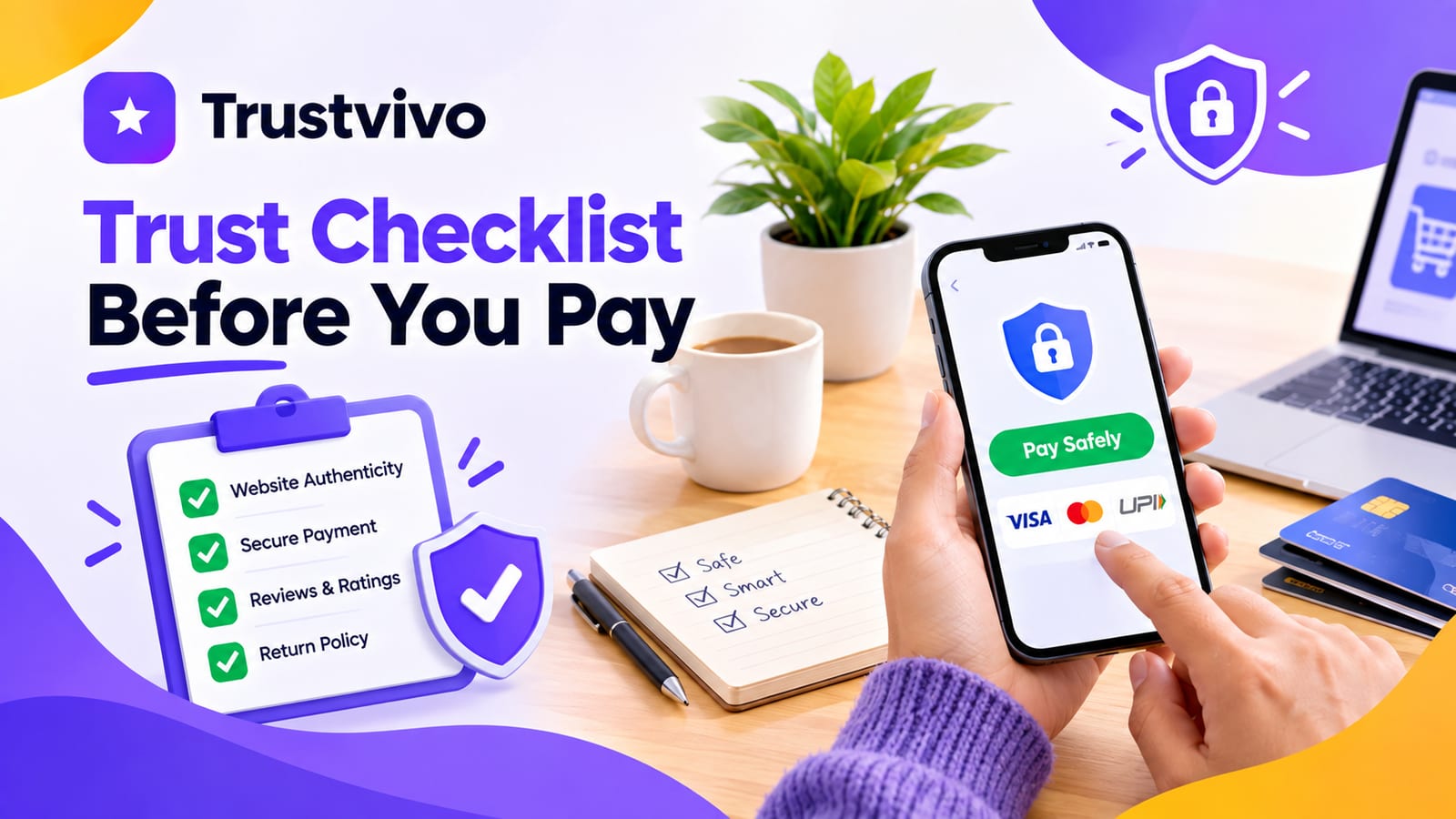
Somewhere between “this looks like a good deal” and “I’ve just paid” is a five-minute window where a little diligence prevents most bad purchases. Almost everyone who searches for how to check a company before buying is really asking one of two more specific questions: “how to verify a business is genuine” for a company they’ve never dealt with, or “how to check if a seller is trustworthy” on a marketplace where the platform’s brand reputation doesn’t automatically extend to every individual seller.
This is the checklist we’d want every buyer to run before paying — not after something has already gone wrong.
Step 1: Confirm the company actually exists as a real entity
This is the most basic check and the one people skip most often when a deal feels urgent or too good to pass up.
- Look for a registered business name, address, and GST or company registration number — usually in the website footer, an “About” page, or invoice template. A company with none of this, especially one asking for advance payment, is a meaningful red flag.
- Check how long the business has existed. A newly registered domain or a business with zero online footprint before this month isn’t automatically fraudulent, but it removes an entire category of verification (review history, past customer experience) that older, established businesses provide.
- Search the exact company name, not just a brand name, since many businesses trade under a name different from their registered legal entity — and scammers frequently borrow a legitimate-sounding brand name while operating under something else entirely.
Step 2: Check independent reviews, not just the ones on the seller’s own site
Reviews embedded directly on a company’s own website can be selectively curated — even without outright fabrication, a business chooses which testimonials to feature. Independent review platforms, where a company can’t simply delete reviews it dislikes, tell a more complete story.
When you check a company’s profile on Trustvivo or any similar platform, apply the pattern-recognition skills from our guide on the five fingerprints of a fake review:
- Is there a natural, steady spread of reviews over time, or a suspicious burst?
- Do reviews mention specific, checkable details — an order number, a delivery date, a support interaction — or just vague superlatives?
- Does the rating distribution have a real middle, or is it suspiciously all five-star and one-star?
- Click a reviewer’s profile occasionally — does their history look like a real person’s, or a template farm?
Step 3: Separate the platform’s reputation from the seller’s, on any marketplace
If you’re buying through a marketplace rather than directly from a retailer, remember that the marketplace’s overall brand trust does not automatically extend to every individual seller listed on it — a point we cover in more depth in which online stores in India actually deliver what they promise. Check the specific seller’s own rating and recent review history, not just the platform’s brand-level trust signals.
Step 4: Verify the payment flow is protected, not a workaround
This step matters most for anything outside a standard, secure checkout page:
- HTTPS with a valid certificate is table stakes — if a checkout page isn’t secured, stop there.
- Be wary of any seller who asks you to pay outside the platform’s protected checkout — a direct bank transfer or UPI payment to “save on fees,” for example — since this typically forfeits any buyer protection the platform would otherwise provide.
- For high-value purchases, especially from a business you’ve never dealt with before, consider a payment method that offers dispute or chargeback protection over a direct, irreversible transfer.
Step 5: Read the return, refund, and cancellation policy before you need it
Nearly every company’s terms page states a return policy. What matters is whether it holds up in practice — which is exactly the kind of thing reviews can tell you and marketing copy can’t. Look specifically for reviews describing an actual return or refund experience, not just the stated policy, echoing the same advice in our piece on evaluating e-commerce sites.
Step 6: For insurance, financial products, and anything claim-based, look past the sale
If the “company” in question sells insurance, financial products, or any service where the real test comes long after purchase, the checklist above needs one more layer: look specifically for reviews describing what happened when a customer needed the product to perform — a claim, a payout, a service escalation — not just what happened when they bought it. We go into this in detail for health insurance and travel insurance, and the underlying principle generalizes to any product where the sale and the real test are separated by months or years.
Step 7: Watch for the specific tactics fraudulent operations rely on
Beyond the general verification steps above, a few specific tactics show up repeatedly across fraudulent or high-risk operations in India, and recognizing them by name makes them far easier to catch in the moment.
- Artificial urgency. “Offer expires in 2 hours,” a countdown timer that resets on refresh, or a salesperson pushing you to decide before you can verify anything independently. Legitimate businesses selling legitimate products rarely need to rush you past basic diligence — urgency is a tool specifically for preventing verification, not a natural feature of a good deal.
- Payment collection before service delivery, with no recourse if it fails. This is standard for most e-commerce (you pay, then receive), but becomes a red flag specifically when combined with a payment method that offers no dispute mechanism — a direct bank transfer, a personal UPI ID, or cryptocurrency, particularly for services (as opposed to physical goods) where there’s no delivery tracking to fall back on if something goes wrong.
- Look-alike domains and brand impersonation. A domain that’s a single character off from a well-known brand (an extra letter, a hyphen, a different top-level domain) is one of the most common phishing and scam patterns. Always type a known brand’s URL directly or use a saved bookmark rather than clicking a link from an SMS, WhatsApp message, or ad, especially for banking or payment-related actions.
- Fake urgency around “limited stock” combined with a price far below every competitor. A single deeply discounted item can be a genuine clearance sale. An entire storefront of premium-brand items at a fraction of market price, with no clear liquidation story, is one of the more reliable single signals of a fraudulent listing.
- Requests to move the conversation off the platform. On marketplaces, social commerce, or classifieds sites, a seller asking to continue via personal WhatsApp or email specifically to arrange payment outside the platform is deliberately stepping outside whatever buyer protection the platform offers — a tactic worth treating as disqualifying on its own for any transaction of meaningful value.
How to verify specific regulated categories in India
For a subset of high-stakes purchases, India has specific regulator-maintained registries that let you verify legitimacy directly at the source, rather than relying on the business’s own claims:
- Companies and LLPs: The Ministry of Corporate Affairs (MCA) portal maintains a public company/LLP search by name or Corporate Identification Number (CIN), showing registration status and filing history.
- GST-registered businesses: The GST portal’s “Search Taxpayer” tool verifies a GSTIN and confirms whether it’s active, for any business dealing in goods or services above the applicable threshold.
- NBFCs and lending apps: The Reserve Bank of India (RBI) publishes a list of registered Non-Banking Financial Companies. A lending app or platform not on this list, or not partnered with a regulated entity that is, is operating outside RBI’s regulatory perimeter — a serious concern given how much digital lending fraud specifically exploits this gap.
- Insurance companies and intermediaries: IRDAI maintains a public register of licensed insurers and registered intermediaries (agents, brokers, web aggregators). Any entity selling insurance-like products without appearing on this register should be treated as high-risk regardless of how polished its marketing looks.
- Investment advisers and brokers: SEBI maintains a searchable register of registered investment advisers, brokers, and portfolio managers. Unregistered “investment advice” — especially via social media DMs or unsolicited Telegram/WhatsApp groups promising guaranteed returns — is one of the fastest-growing fraud categories in India specifically because it operates entirely outside any of these verifiable registries.
Running the relevant registry check for a regulated category takes two or three minutes and is dramatically more reliable than any review, testimonial, or marketing claim, because it’s independently maintained by the regulator itself rather than by the business being verified.
A quick-reference version of the checklist
- Registered business name, address, and GST/company details visible and verifiable.
- Independent review history — not just testimonials on the seller’s own site — with a natural spread of ratings and specific, checkable details.
- If buying via a marketplace, the specific seller’s rating checked separately from the platform’s overall brand reputation.
- Secure, protected checkout — HTTPS, and payment kept within the platform’s protected flow rather than a direct transfer.
- Return/refund policy checked against real reviews describing an actual return, not just the stated terms.
- For anything claim- or service-based, reviews specifically describing the post-purchase experience, not just the buying experience.
A worked example: applying the checklist to a real scenario
To make the checklist concrete, walk through how it applies to a common scenario: an ad for a home-décor brand you’ve never heard of shows up in your social feed, offering 60% off with a countdown timer and free shipping, payable only via a “special checkout link.”
- Step 1 (entity check): You search the brand name plus “GST” or “company registration” and find no verifiable registration details on the site itself — only a generic contact form, no address, no phone number.
- Step 2 (independent reviews): You search the brand name on an independent review platform and find either no results at all, or a small handful of reviews that all read almost identically (“Amazing quality, fast shipping!”) and were all posted within the same few days.
- Step 4 (payment flow): The “special checkout link” turns out to bypass a standard secure payment gateway, asking instead for a direct UPI transfer to a personal-looking handle rather than a registered business account.
Any one of these findings alone might have an innocent explanation — a very new business, a simple oversight in disclosure. All three together, on a single unfamiliar brand with an urgency-driven ad, is close to a textbook profile of a fraudulent or at minimum high-risk storefront, and it’s exactly the pattern this checklist is built to surface in under five minutes, before any money changes hands.
Why this belongs on a review platform, not just a “how-to” article
None of these steps require special tools or technical skill — they require knowing where to look and what to discount. That’s precisely the gap Trustvivo is built to close: every company profile carries a dated, filterable review history rather than a single flattened star average, and our Trust & Transparency principles commit to publishing our own moderation numbers so the review history you’re relying on has been screened by a system that’s itself auditable.
Running this checklist takes about the same five minutes it takes to add an item to a cart and check out. The businesses that pass it easily — with clear registration details, a real and varied review history, and a return policy that reviewers confirm actually works — are worth your money. The ones that resist basic verification, however good the deal looks, are exactly the ones this checklist exists to catch before you pay, not after.
When to slow down even further
Most day-to-day purchases don’t warrant the full checklist — a familiar, well-established retailer for a modest purchase doesn’t need a CIN lookup. Reserve the complete process specifically for situations where at least one of these is true: the business is entirely unfamiliar to you, the payment method requested falls outside a standard protected checkout, the amount involved would be genuinely painful to lose, or something about the interaction — urgency, an unsolicited approach, a deal that seems disconnected from market reality — has already triggered some hesitation. That hesitation is worth listening to. In nearly every fraud case reviewed after the fact, the person involved describes a moment of doubt they talked themselves out of. The checklist exists to give that doubt somewhere concrete to go, rather than being second-guessed away by urgency or social pressure in the moment.
Want to see the checklist applied to a real purchase? Our TickPick legitimacy breakdown walks through delivery dates, guarantees and fee totals on a resale ticket marketplace.
Frequently asked questions
How do I verify a business is genuine before paying online?
Check for a real registered address and company/GST details, confirm the checkout uses HTTPS with a valid certificate, search the company name plus "reviews" on an independent review platform, look at how long the domain or business has existed, and check whether recent reviews mention specific, verifiable details rather than vague praise or complaints.
How can I check if a seller is trustworthy on a marketplace?
Look at the seller's specific rating (not the marketplace's overall brand rating), read their most recent reviews rather than just their overall score, check how long they've been selling on the platform, and see whether their returns and refunds are handled through the marketplace's protection or entirely at the seller's discretion.
What's the fastest way to check if a company is legit before wiring money?
For any payment made outside a protected checkout flow (bank transfer, UPI to an individual, cash advance), independently verify the company through multiple sources — its own official channels, an independent review platform, and if it's a registered business, its official company registration record — before paying. Never rely solely on documents or links the seller sends you directly, since these can be fabricated.
Are more reviews always a sign a company is more trustworthy?
No. Review volume alone can be manufactured. A smaller number of detailed, specific, recent reviews with a natural spread of ratings is generally more trustworthy than a large volume of near-identical five-star reviews with no real detail.