Is TickPick Legit? What the No-Fee Promise Actually Means for Refunds and Fakes
TickPick's all-in pricing is real, and so is its Buyer Guarantee. Here's what the guarantee actually covers, and the one delivery-timing pattern behind most "is it a scam" complaints.
· Trustvivo Editorial Team
Updated November 9, 2026: fees, guarantee wording, BBB and Trustpilot figures, and the FTC fee rule were re-checked against current sources.
Search "is TickPick legit" and you get a split screen. Reddit threads and Facebook groups ask the question with real worry. TickPick's own pages, a few affiliate-style blogs and a competitor or two all answer yes. Neither side is much use if you are about to spend several hundred dollars on playoff seats. Here is what holds up when you check it. TickPick is a real, long-running New York company with a published guarantee, an A- from the Better Business Bureau and a 4.7 on Trustpilot. The problems buyers report are rarely theft. They are tickets that arrive later than expected, sellers who cancel, and the occasional surprise about seats or refunds. We will go through each, with the numbers and the source for each.
Short answer: legit, with one habit to build
TickPick is a legitimate resale marketplace, not a scam site. It was founded in 2011 and is headquartered in New York City. Wikipedia lists Brett Goldberg and Chris O'Brien as founders and co-CEOs. It raised $40 million from PWP Growth Equity in 2019, and it bought two rivals, RazorGator and Rukkus, in 2018. None of that proves any single order will go smoothly. It does mean you are dealing with an established company that has something to lose, not a pop-up storefront.
The habit worth building is simple. Read the delivery date on the listing and your confirmation before you pay, and contact support the moment that date passes. Almost everything that goes wrong, on TickPick or any other resale site, goes wrong quietly in the gap between "I paid" and "the ticket is in my wallet."
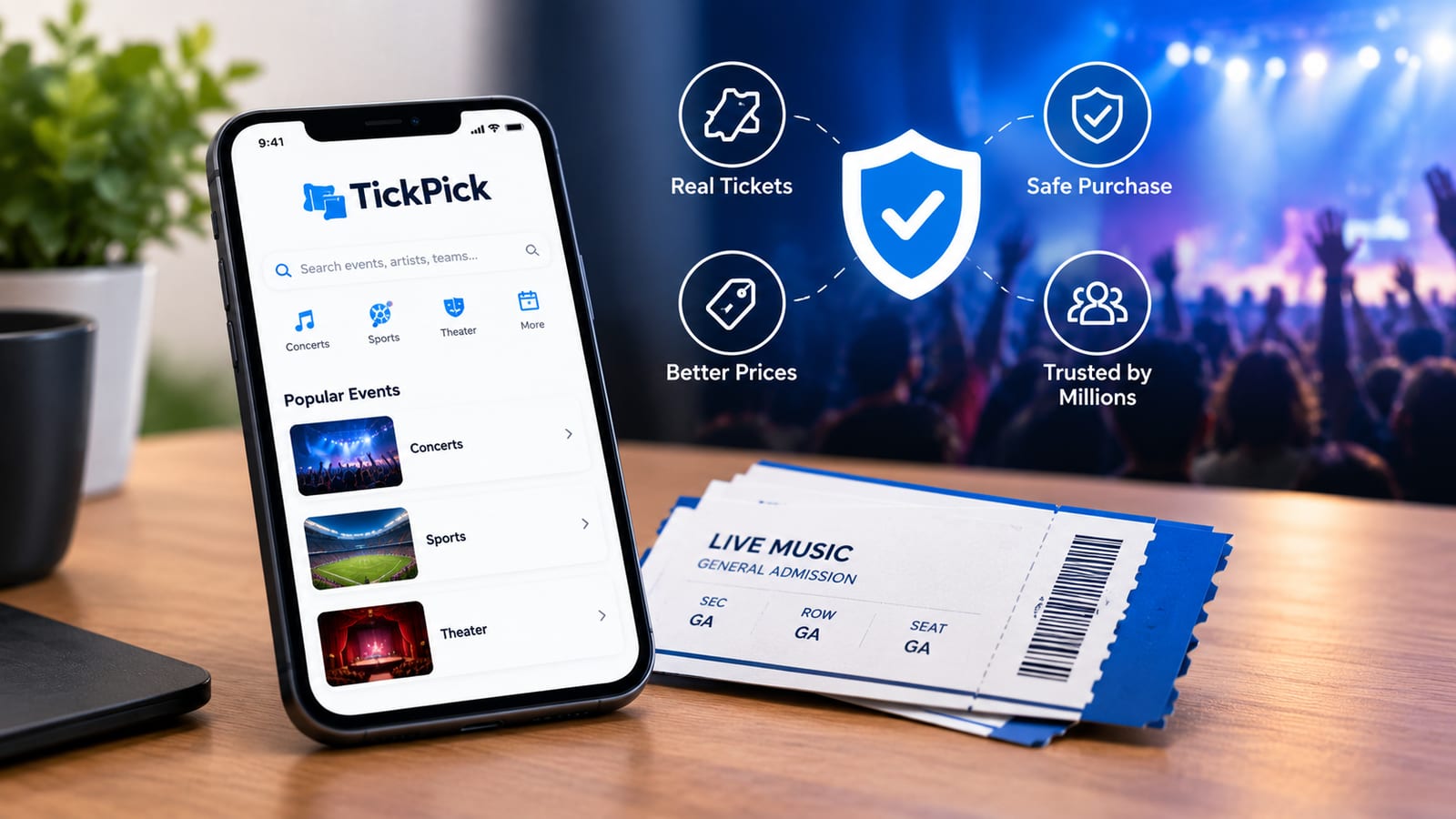
What TickPick is, and how the "no fees" pricing works
TickPick is a secondary marketplace. It is not a box office. Tickets come from season-ticket holders, brokers and individual fans, the same supply pool that feeds StubHub, SeatGeek and Vivid Seats. The price you see on a TickPick listing is the price you pay. TickPick says it charges buyers "$0 in buyer fees." For sellers, resale sites generally charge a commission, and TickPick's own blog does not say what its seller fee is, so we will not guess at a number.
Here is the practical consequence. "No buyer fee" does not automatically mean "cheapest total." A seller's asking price can reflect the seller's own costs. The honest comparison is the final total for the same section and row on each site. TickPick's blog gives these estimates for a $150 ticket, and they are its own numbers, so treat them as a rough guide:
| Site | Typical buyer fee, per TickPick's blog | Estimated total on a $150 ticket |
|---|---|---|
| TickPick | 0% | $150 |
| StubHub | 10-20% | $165-$180 |
| SeatGeek | 10-25% | $165-$188 |
| Vivid Seats | 15-30% | $173-$195 |
Another source, TicketX, puts Vivid Seats at about 10-25 percent and SeatGeek at 10-30 percent, which shows how loose these figures are. Fees move with the event and the demand. The only number that counts is the one on your own checkout screen.
The FTC fee rule changed this comparison
A year ago, "TickPick shows the real price" was a big advantage. It is a smaller one now. The FTC's Rule on Unfair or Deceptive Fees (16 CFR Part 464) took effect on May 12, 2025. For live-event tickets, sellers must show the total price, including mandatory fees, up front, and display it at least as prominently as any other price. Government charges, shipping and optional add-ons are the usual exceptions. The FTC later settled with StubHub over this rule, with roughly $10 million in refunds for customers who bought US event tickets on May 12 to 14, 2025, according to news coverage of the settlement.
So the useful question has changed. It is no longer "who hides fees?" It is "how big is the total, and how clearly is it shown before I enter my card?" TickPick still has the cleanest answer to that, because there is no fee to disclose on the buyer side. But you can now compare totals on rival sites at the listing stage, so do that for any ticket over a hundred dollars.
What the BuyerTrust Guarantee covers
An older version of this article called it the "100% Buyer Guarantee." TickPick now calls it the BuyerTrust Guarantee. Its published promise is that every ticket will be valid for entry and will arrive in time for the event. If there is a problem, TickPick says it will provide replacement tickets of equal or greater value, or refund you. If an event is cancelled and not rescheduled, you get a full refund. If it is postponed, your tickets stay valid for the new date.
Three limits matter. First, it does not cover a change of mind. If you simply cannot go, you resell the ticket. Second, a postponement is not a cancellation, so you keep your tickets for the new date and do not get your money back by default. Third, the guarantee applies to purchases made through TickPick's checkout. Pay a seller on the side and you have nothing to claim.
For the "I cannot go" case, TickPick began offering optional ticket insurance in January 2026, called Event Ticket Protector and underwritten through XCover. It is for US buyers, it costs extra, and it covers reasons such as illness or an accident on the way to the venue, with terms and exclusions. It is a separate product from the free BuyerTrust Guarantee. One thing to know about the "BestPrice Guarantee" that TickPick also advertises: a third-party guide reports that its credit is capped and expires, with exclusions. We could not confirm the exact figures from TickPick's own pages, so read that policy before you plan around it.
How it compares with StubHub, SeatGeek and Vivid Seats
On paper the big four promise almost the same thing: a valid ticket, delivered in time, with a replacement or refund if not. StubHub's FanProtect applies automatically at no extra charge, matches replacements on original price, seat location and availability, and refunds cancelled events that are not rescheduled. StubHub's own guidance says to document any problem and contact it "ideally the same day." Its postponed events keep tickets valid for the new date, the same as TickPick. SeatGeek's guarantee covers orders that arrive late, are invalid, or are not what you ordered. Vivid Seats calls its version the 100% Buyer Guarantee.
Since the wording is so close, the better test is the track record: how many complaints, how they are answered, and how clearly each listing states delivery. Do not pick a site because it is the most advertised. A bigger name does not make a ticket safer. Even StubHub faces a class action alleging it does not honor its guarantee, which a court sent to arbitration. That is one allegation, not a ruling, but it shows why the written promise is not the whole story.
What the review sites show: BBB, Trustpilot, ResellerRatings
As of November 9, 2026:
- BBB: Tickpick LLC is accredited, an A- rating, accredited since March 3, 2014. BBB shows 570 complaints filed in the past three years and 204 in the past 12 months, plus 687 customer reviews. That is a real number of complaints for a company this size. BBB does not report an average, so read the complaints themselves, not just the letter grade. Accreditation is paid and rated by complaint handling, not a safety certificate.
- Trustpilot: 4.7 out of 5 from 6,069 reviews, with 89 percent five-star and 7 percent one-star. TickPick replies to about 95 percent of negative reviews, usually within a week. The shape of the ratings is the usual one for a high-volume marketplace: lots of happy buyers, plus a thin tail of angry ones. Our guide to why star ratings alone mislead explains how to read that shape.
- ResellerRatings: 2,956 reviews are listed.
- App stores: TickPick cites 4.8 on Google Play and 4.9 on the Apple App Store. Those are its own figures, and app ratings lean positive, so we give them little weight.
We could not read the Reddit and Facebook threads that rank for this search, because those sites block automated reading. We saw only the search snippets, which show buyers asking whether the site is okay and replies saying it is generally safe with buyer protection. We have not leaned on them.
The real complaint pattern: late tickets and cancelled orders
Read the one- and two-star Trustpilot reviews and the themes repeat. They are delivery timing as the event approaches, unexpected seat changes, obstructed views, unfulfilled seller orders, and confusion over how to claim tickets from the delivery email. Few say the ticket was fake.
Delivery timing is mostly how resale works. A large share of tickets are mobile transfers released through the venue's app, and the holder often cannot or does not send them until a day or two before the event. Some reviewers praise exactly that: tickets landed two days before a hockey game and everything was fine. Others were still waiting on the day, or bought hours before puck drop and the original tickets never came. In replies to reviews, TickPick points to its guarantee: you get the tickets you bought, or comparable or better replacements.
The seat-change complaint is worth understanding. In one reply on Trustpilot, TickPick said it is a secondary marketplace, independent sellers fulfill orders, and its policy requires buyers to confirm replacement offers. So a "we replaced your seats" email the night before a show is the guarantee working, but it can feel like a bait and switch if you did not expect it. Reply promptly and compare the replacement with what you paid for.
How to check a listing before you pay
Most avoidable risk sits in a few checks you can run in two minutes. They follow the same logic as our trust checklist before you pay, applied to tickets.
- Read the delivery method and date. A listing that delivers "within 24 hours of the event" is telling you it is late-release mobile transfer. That is not a red flag, but do not book non-refundable flights on the strength of it.
- Distrust a price far below every other listing for the same section. It is the oldest warning sign. Either the seller does not have the ticket yet or is gambling on sourcing it later.
- Check the section, row and view notes against the venue's seating chart before checkout, not after.
- Compare totals across two or three sites, with every fee included, for the exact same seats.
- Take screenshots of the listing and the order confirmation. They are your evidence if you need to invoke the guarantee.
- Set your own deadline. If nothing has arrived by the stated delivery date, contact support that day. Do not wait for the event.
- Pay by credit card. It adds a chargeback route through your card issuer, on a separate timeline from the platform's guarantee.
- Stay inside the checkout. TickPick's own scam guidance lists payment by wire transfer, crypto or gift cards, ticket screenshots instead of platform delivery, and no buyer protection as red flags. That advice is sound for any ticket site, even though it comes from a company that wants your business.
For a business you are not sure about, our 6-point business legitimacy check works on anything, and the online scam checker guide covers the tools to run before you hand over card details.
Is TickPick licensed? What regulation actually exists
Ticket resale in the US has no single license, unlike securities brokerage. What exists is a patchwork. The FTC's fee rule applies nationally. Several states, including New York and Minnesota, have their own ticket-pricing and disclosure laws. State rules vary, and they change, so we will not summarize any one of them here. The practical checks are the ones you can run yourself. Does the total match what is charged? Does a cancelled-event refund actually arrive? Both are checkable on your own order.
The marketplace-and-guarantor model is not unique to tickets. It is the same structure behind sports memorabilia and mystery-box platforms, where the company arbitrates between buyer and seller. The same read-the-terms-first discipline applies to marketplaces with all-sales-final policies.
How refunds and replacements play out
TickPick's guarantee says replacement or refund. Replacements usually resolve fastest because no banking step is involved. TickPick reassigns another listing to your order. For a refund, the money goes back to your original payment method, and your card issuer can take several days to post it, so a same-day look at your statement tells you little. We could not find a TickPick-specific refund timeline in its published terms. Ask support for the date when they approve one, and write it down. StubHub, for comparison, says refunds for cancelled events typically process in 5 to 10 business days.
Red flags that apply to any ticket marketplace
- A price dramatically below comparable listings. Seller either lacks the inventory or plans to buy it after you pay.
- A thin seller history on a sold-out show. New sellers are not always bad, but a new account plus a cheap price on a high-demand event raises the odds of a late cancellation.
- Anyone asking you to pay or message off the platform. That bypasses the guarantee entirely. When this shows up in complaints, it is a third party trying to route around the platform, not the platform asking.
These are the same tells our guide to spotting fake reviews describes for product listings: too good, too new, too keen to move you elsewhere.
Our verdict
TickPick is a reasonable place to buy resale tickets, and its no-buyer-fee pricing makes totals easy to compare. Its guarantee is on par with the big rivals and is clearly published. Its record is good on Trustpilot and respectable on BBB, with a visible stream of complaints that cluster around delivery timing and seller cancellations. Buy with a card, read the delivery date, screenshot everything, and escalate on the first missed deadline, not the day of the show. If a listing fails any of those checks, move to another seller on any platform rather than hoping the guarantee will rescue it.
The sources behind this page are TickPick's own pages and blog (company claims, labelled as such), BBB, Trustpilot, ResellerRatings, Wikipedia, StubHub's newsroom, the FTC rule text, and news coverage of the StubHub settlement. Figures were read on November 9, 2026 and will drift, so check the live pages before a large purchase.
Frequently asked questions
Is TickPick a legitimate ticket marketplace?
Yes. TickPick has operated since 2011 as a New York based resale marketplace, has been BBB accredited since March 2014 with an A- rating, and backs every order with its BuyerTrust Guarantee. Like every resale site, it still has complaints, mostly about late ticket delivery and seller cancellations.
Does TickPick really have no fees?
TickPick charges buyers no service fee, and the price on the listing is the price you pay at checkout. That is a buyer-side claim. Sellers pay to list, and resale prices are set by sellers, so compare the final total on the exact seats across sites instead of assuming TickPick is always cheapest.
What does the BuyerTrust Guarantee cover?
TickPick says every ticket will be valid for entry and arrive in time for the event. If something goes wrong it promises replacement tickets of equal or greater value, or a refund. If an event is cancelled and not rescheduled you get a full refund, and a postponed event keeps your tickets valid for the new date. It does not cover a change of mind.
How does TickPick compare to StubHub and SeatGeek on fees?
TickPick's own blog estimates buyer fees of roughly 10 to 20 percent on StubHub, 10 to 25 percent on SeatGeek and 15 to 30 percent on Vivid Seats, against zero on TickPick. Those are TickPick's estimates, not audited figures. Since the FTC's fee rule took effect on May 12, 2025, every US ticket seller must show the full price up front, so the gap you see at checkout is now easier to check.
Why do some TickPick tickets arrive so close to the event?
Many resale tickets are mobile transfers that the original holder releases through the venue's own app, often only a day or two before the event. Delivery timing is the most common theme in TickPick's Trustpilot complaints, and it is not unique to TickPick.
What should I do if my TickPick ticket has not arrived?
Check the delivery date on your order confirmation. If that date has passed, or the event is within a day or two and you have nothing, contact TickPick support right away and say you are invoking the BuyerTrust Guarantee. Keep screenshots of the order and the listing.
What do BBB and Trustpilot say about TickPick?
As of November 9, 2026, BBB lists Tickpick LLC as accredited since March 3, 2014 with an A- rating, with 570 complaints filed in the past three years and 204 in the past 12 months. Trustpilot shows 4.7 out of 5 from 6,069 reviews, with 89 percent five-star and 7 percent one-star. Check both pages again before a big purchase, because the numbers move.
Does TickPick offer ticket insurance?
Since January 2026 TickPick has offered optional Event Ticket Protector coverage, underwritten through XCover, for US buyers. It costs extra and covers personal reasons you cannot attend, such as illness or an accident. That is separate from the BuyerTrust Guarantee, which is included free with every order.
Is it safer to pay for TickPick tickets by credit card?
Generally yes. A card gives you a chargeback route through your card issuer, which runs on its own timeline and is separate from TickPick's guarantee process. Use TickPick's own checkout, never a side payment through a message or a payment app.