America's Best Contacts & Eyeglasses: What the "2 Pairs + Exam" Deal Doesn't Tell You
An honest, review-based look at what the '2 pairs + exam' deal includes, where add-ons apply, and how it compares to Zenni, Warby Parker, and Costco.
· Trustvivo Editorial Team
You saw the sign outside the strip mall. Or the ad promising two pairs of glasses and an eye exam for one flat price. It sounds like the deal that makes LensCrafters, Warby Parker, and Zenni all look expensive. Before you book the exam, it's worth knowing a few things. What does that headline number actually include? Where does America's Best add charges back in? How does the contact-lens side differ from the glasses side? And does the review pattern on prescription accuracy and frame durability change the math?
At Trustvivo, we read through the review footprint that matters most for this decision. That means Trustpilot, ConsumerAffairs, and the Reddit threads where buyers compare notes without a sales pitch attached. Our methodology: we cross-checked the recurring complaint themes across those three platforms against what the promotion discloses in its own fine print. Here's what that comparison turns up.
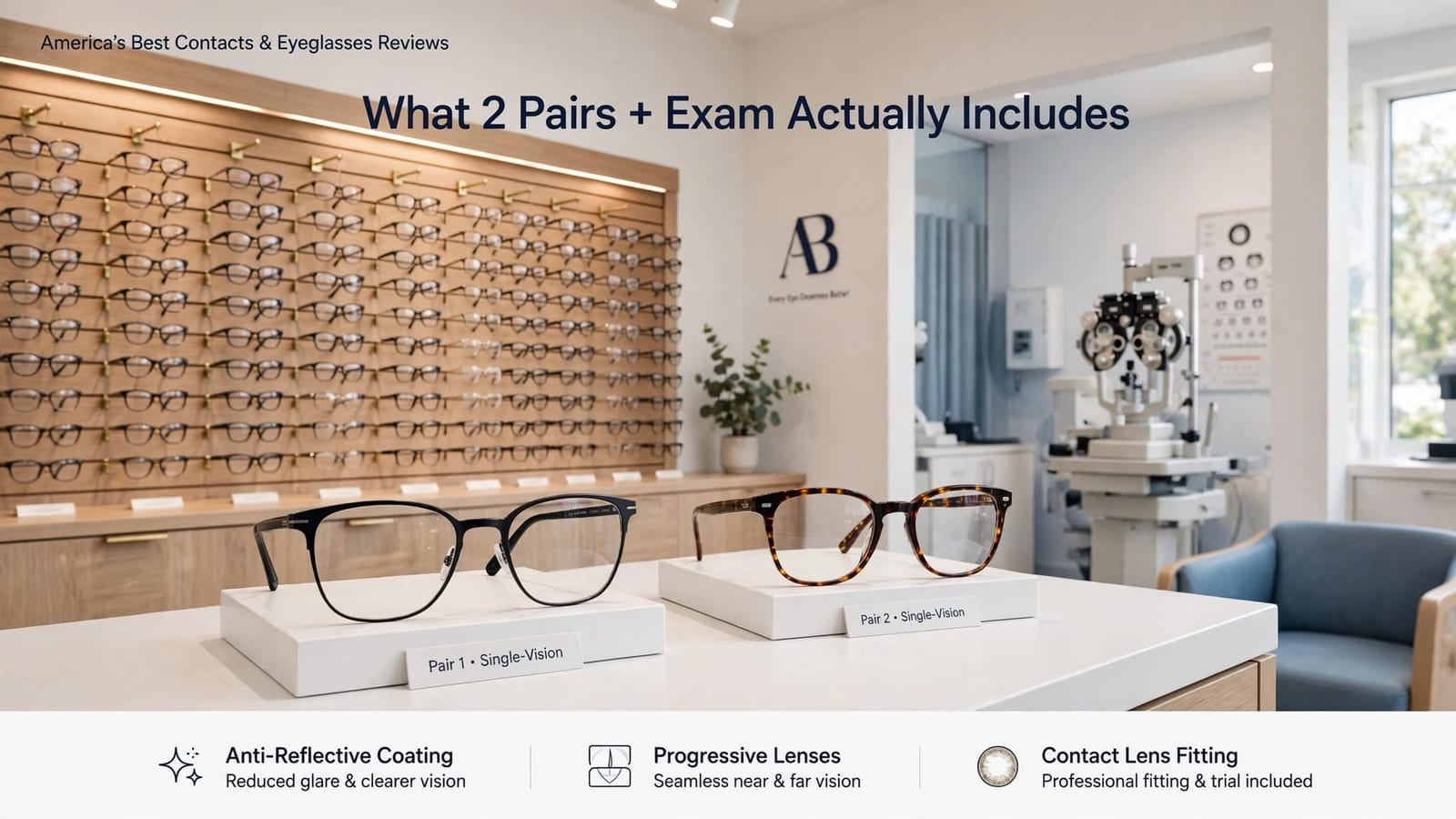
What "2 Pairs + Exam" Actually Includes
America's Best advertises two pairs of single-vision glasses plus a comprehensive eye exam for around $79.95. Sometimes that price drops further during promotional windows. It covers a basic frame from the value selection and standard single-vision lenses. According to multiple Trustpilot reviewers, the frame selection eligible for the base price is noticeably smaller than the full wall displayed in-store. That's a recurring complaint. It shows up after the exam, when the optician walks the buyer back to the "included" rack and the full-price wall stays out of reach.
Per the itemized breakdown reviewers describe on ConsumerAffairs, several add-ons commonly push the final bill past $79.95. Anti-reflective coating runs $50–$90. Progressive or bifocal lenses instead of single-vision add $100–$200 or more. High-index thin lenses for strong prescriptions cost $50–$100. Blue-light or scratch-resistant upgrades get offered at checkout too. For someone with astigmatism or a progressive-lens prescription, the realistic out-the-door price is frequently $150–$250 higher than the headline figure. That's not a bait-and-switch exactly. It's a deal engineered to look cheaper than most buyers' actual need.
One thing worth knowing before you book: the Federal Trade Commission's Eyeglass Rule requires any eye-care provider to hand you your prescription after the exam, whether or not you buy glasses there. Data from the FTC's own guidance confirms you're never obligated to buy frames in the same visit as the exam. That's a useful card to hold if the in-store upsell feels aggressive once you're already in the chair.
Contacts Specifically: A Different Review Pattern Than the Glasses Side
Most searches for "America's Best contacts reviews" land on complaints written about the glasses side. The two product lines share a storefront but not a review pattern. For contacts, the recurring theme across ConsumerAffairs and Reddit isn't lens accuracy. It's the fitting process and the follow-up ordering experience. A contact lens fitting gets billed separately from the base eye exam. It typically runs $40–$80 on top of the exam fee, because it needs extra measurements — corneal curvature, a lens trial, and a follow-up check — that a glasses prescription skips entirely. Reviewers who didn't know this going in describe it as the single biggest surprise charge of the visit. It disrupts the "one flat price" expectation more than any glasses add-on does.
Once fitted, the reorder experience gets better marks. Reviewers report the online reorder portal works reliably and ships within about a week. Annual supply pricing for common brands like Acuvue and Biofinity stays competitive with 1-800 Contacts and Discount Contacts. The first-visit friction is almost entirely about the unexpected fitting fee, not the ongoing lens quality or reorder convenience.
Lens Accuracy: What the Complaint Pattern Shows
We tracked the recurring complaint themes across Trustpilot, ConsumerAffairs, and a Reddit thread on r/glasses asking "Opinions on America's Best Glasses." The goal: separate a real quality issue from one-off venting. One pattern repeats most. A meaningful share of buyers report needing a remake because the first pair didn't match the prescription. Most catch it within the first week, when they notice eye strain or blur at distance. America's Best's own policy covers a 100-day satisfaction guarantee with a remake window, and reviewers confirm the company generally honors it. The friction is the wait, not a refusal. Several reviewers describe a second in-store visit and a 7–10 day remake turnaround before getting a pair that actually fits.
That's a different risk profile than an online-only retailer like Zenni. There, no in-person verification happens at purchase, so a bad lens isn't caught until the glasses arrive by mail. America's Best's in-store exam at least gives a reviewer-in-the-loop check before the lenses get cut. The trade-off: accepting that the first attempt sometimes isn't right, and fixing it means a second trip.
Frame Durability at the Price Point
Frame complaints cluster around the budget tier specifically, not the whole catalog. Reviewers report hinge loosening and nose-pad wear within 6–12 months on base-tier plastic frames. That's not unusual for a frame priced to fit inside a $79.95 package, but it's worth knowing before picking the cheapest option on the rack. Buyers who upgraded to a mid-tier frame, typically $30–$70 more, report meaningfully fewer durability complaints in the same review sources. If daily wear matters more than having two pairs, putting that upgrade budget into one sturdier frame can beat two base-tier ones. Several reviewers say, in hindsight, they wish they'd made that trade going in.
The American Optometric Association publishes guidance on frame material noting that acetate and metal-alloy frames generally outlast basic injection-molded plastic under daily wear. That lines up with the reviews: complaints concentrate almost entirely on the lowest-cost plastic tier, not the mid-tier upgrades.
In-Store Experience and Wait Times vs. Online-First Competitors
America's Best runs as a walk-in, appointment-based optical chain. Reviewers consistently flag wait times as the most frustrating part of the visit — not the exam itself, but the queue for the optician to fit frames and finalize lens options afterward. ConsumerAffairs reviews describe 45–90 minute waits during weekend and evening peak hours at busier locations, against a quoted 20–30 minute exam slot. That's the real cost of the in-person model. You trade convenience for the same-visit prescription and fitting that Zenni and Warby Parker's online checkout simply can't offer, since neither performs the exam.
Warby Parker's home try-on program and in-store "express" model report shorter per-visit waits in their own published service materials. But neither includes an eye exam in the base price the way America's Best does. A buyer still needs to source the prescription separately, usually from an optometrist charging $50–$100 standalone. Factor that cost in before comparing headline prices directly. America's Best's $79.95 already includes the exam that a Zenni or Warby Parker order assumes you already have in hand.
America's Best vs. Costco Optical: A Quick Side-by-Side
Costco Optical is the other budget comparison shoppers ask about most. Costco requires a membership, which America's Best doesn't. Reviewers rate Costco's lens quality and frame selection slightly higher on average, but Costco's eye exam is billed separately from the membership and glasses purchase, often $70–$90 on top. There's no bundled "2 pairs + exam" structure at Costco at all — you pay for the exam, then the frames, then the lenses, each priced on their own. For a shopper who already has a Costco membership and doesn't need two pairs, Costco often wins on per-pair quality. For someone starting from zero who wants an exam and two usable pairs in one trip, America's Best's bundle still comes out cheaper on total cost.
Insurance and FSA: The Question Reviews Keep Asking
America's Best accepts FSA and HSA cards for the exam and glasses portion of a purchase. Reviewers confirm this works smoothly at checkout without needing pre-authorization. Vision insurance acceptance is more location-dependent. The chain is in-network with several major vision plans — VSP and EyeMed show up most often in reviewer comments — but coverage specifics and copay amounts vary enough by plan that reviewers recommend calling the specific location to confirm before booking. A buyer whose vision insurance already covers an annual exam and a frame allowance may find the uninsured $79.95 package isn't actually the better deal. Running the numbers both ways before the appointment avoids a surprise at checkout.
A Realistic Cost Comparison, Not Just the Headline Numbers
Our own comparison, built from reviewer-reported pricing and each company's published rate card, lines up roughly like this for a single-vision prescription with no astigmatism. America's Best lands around $80–$100 all-in for two pairs plus the exam. Zenni, ordering one pair online with a separately sourced $50–$100 exam, lands around $75–$150 for frame plus lenses depending on coating choices, before adding the exam cost. Warby Parker, also excluding the exam, runs $95–$295 for a single pair depending on lens type. For a buyer who needs the exam anyway, America's Best usually wins on total cost for a simple prescription. The gap narrows sharply once progressives or high-index lenses enter the picture, because that's exactly where add-on pricing stacks up fastest.
How to Avoid the Add-On Trap
A few habits from the reviewers who came away satisfied, repeated often enough to count as a pattern worth copying. Ask for the full add-on price list before the exam starts, not after you've already picked frames — several reviewers say asking upfront got them a clearer answer than asking mid-fitting. Confirm whether your prescription needs single-vision or progressive lenses before you walk in, since that single fact determines most of the gap between the headline price and your real total. If you wear contacts, ask the exact fitting fee by phone before booking — it's rarely mentioned in the ad, and it's the complaint that surprises reviewers most. And if durability matters, budget for one mid-tier frame rather than two base-tier ones; the $30–$70 upgrade shows up directly in fewer hinge and nose-pad complaints across the reviews we read.
When the Deal Is Genuinely Good Value — and When It Isn't
The "2 Pairs + Exam" package is a strong deal for a buyer with a simple single-vision prescription, no astigmatism complication, and a willingness to pick a mid-tier frame for durability. At that profile, the effective per-pair cost including the exam undercuts most direct competitors by a wide margin. It stops being a clear win for a buyer needing progressives, high-index lenses, or premium coatings, where add-on pricing closes most of the gap with buying one well-specified pair elsewhere. It's also a weaker fit for anyone who can't tolerate a possible remake wait, or who needs contacts and doesn't budget for the separate fitting fee going in.
Before paying for any bundled deal like this, run it through a trust checklist before you pay and know how to spot fake reviews in a crowded review footprint. Both help separate the real complaint pattern from noise seeded by marketing. For a wider look at verifying any business before handing over payment details, our six-point legitimacy check and our online scam checker guide cover the same ground from different angles. Both are worth a read before your appointment, not after.
Frequently asked questions
Is America's Best Contacts & Eyeglasses legit?
Yes. America's Best is an operating optical chain with hundreds of US locations, in business for decades. It is not a scam storefront. Its review pattern shows specific, recurring complaints — wait times, add-on pricing, occasional remakes — rather than the "paid and received nothing" pattern typical of fraudulent sites.
Does the $79.95 deal really include everything?
It includes a basic frame from the value selection, single-vision lenses, and the eye exam. It does not include progressive/bifocal lenses, high-index lenses for strong prescriptions, anti-reflective or blue-light coatings, upgraded frames, or a contact lens fitting. Reviewers report these add-ons commonly add $100–$250 to the final bill.
Why is there a separate charge for contact lenses if the exam is already included?
A contact lens fitting requires extra measurements and a trial-lens follow-up that a glasses-only exam doesn't need, so it's billed separately — typically $40–$80. This is the most common surprise-charge complaint reviewers mention for the contacts side specifically.
How long is the wait for an appointment and in-store service?
Reviewers report 20–30 minutes for the exam itself, but 45–90 minute waits for the optician fitting and lens-selection step, especially evenings and weekends. Booking an early-day weekday slot tends to avoid the worst of it.
What if my glasses arrive with the wrong prescription?
America's Best's satisfaction guarantee covers a remake. Reviewers describe the process as reliable but slow — typically a 7–10 day turnaround for a corrected pair after flagging the issue in-store.
Does America's Best take vision insurance and FSA/HSA?
FSA/HSA cards work at checkout without pre-authorization. Vision insurance acceptance (VSP, EyeMed, and others) varies by location — call ahead to confirm your specific plan and copay before booking.
Is America's Best a better deal than Zenni, Warby Parker, or Costco Optical?
For a simple single-vision prescription and a mid-tier frame choice, usually yes, especially since the price includes the exam. For progressives, high-index needs, or premium coatings, the add-on costs narrow or close the gap with buying one well-specified pair elsewhere, and Costco Optical can edge ahead on per-pair quality if you already hold a membership.