Is [Company] Legit? The 6-Point Check We Run Before Trusting Any Business
Wondering is a website safe to buy from, or if a brand's reviews are real or fake? Run this 6-point legitimacy check before you enter your card details anywhere.
· Trustvivo Editorial Team
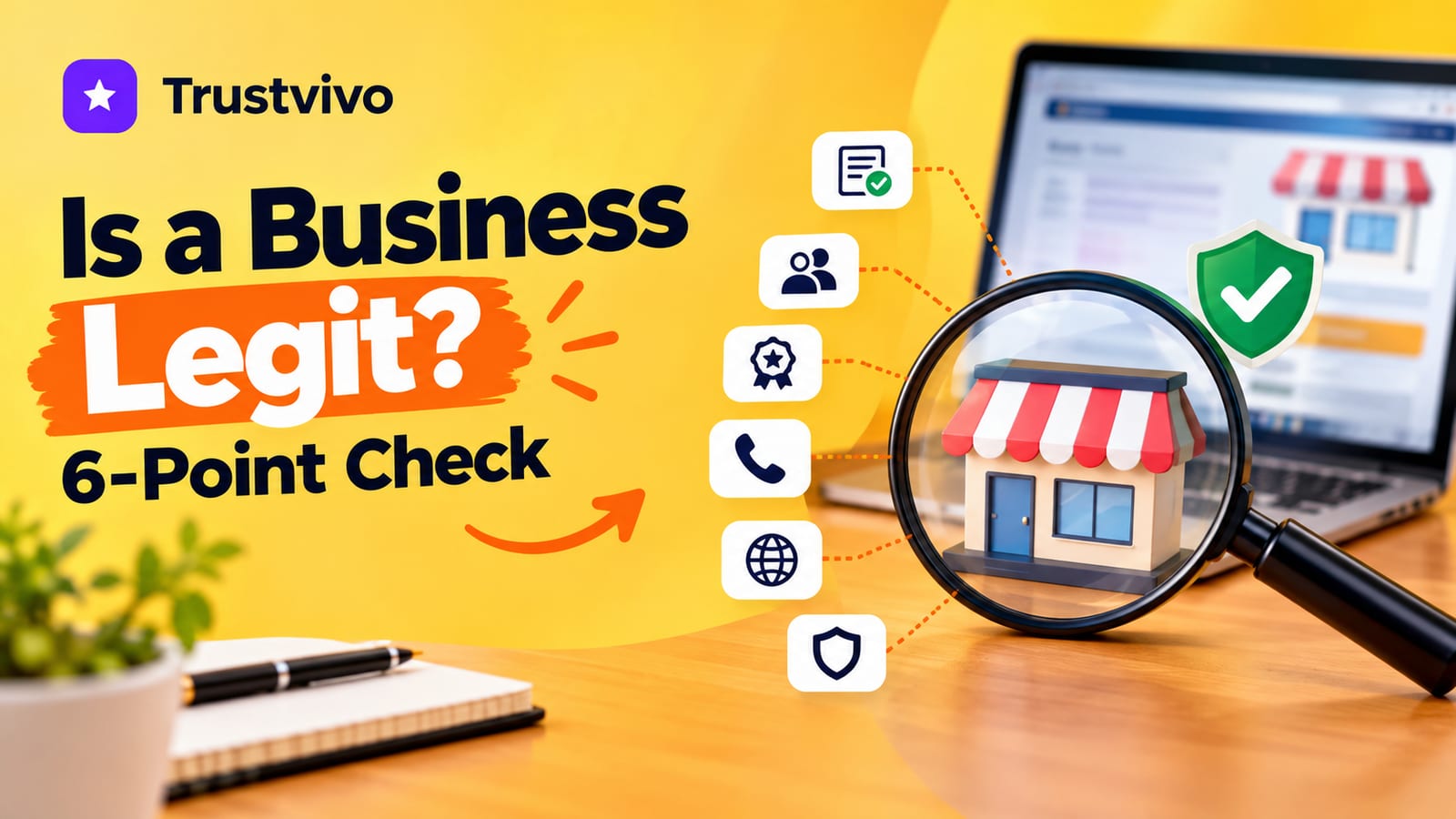
“Is [Company] legit?” is one of the most common searches a person makes right before they’re about to hand over money to a business they’ve never dealt with. It usually happens at a specific, slightly anxious moment: a discounted gift-card deal that looks too good, an unfamiliar website that showed up in an ad, a new investment app a friend mentioned, or a service provider found through a quick search. The instinct to check first is the right one. What most people lack is a repeatable framework for what to actually check, so they end up doing a single search, skimming two results, and deciding based on vibes.
Here is the six-point check worth running on any business, brand, or website before you trust it with your money or your data — whether it’s an e-commerce store, a financial app, or a local service provider.
1. Registration and legal identity
Every legitimate business operating in India has some form of verifiable legal identity — a Company Identification Number (CIN) if it’s registered under the Companies Act and searchable on the Ministry of Corporate Affairs (MCA) portal, a GST registration number if it deals in goods or services above the applicable threshold, or, for smaller sole proprietorships, at minimum a consistent, verifiable business address and contact information rather than only a WhatsApp number and a generic email.
What to check: Look for a CIN or GST number displayed on the website (often in the footer or “About Us” / “Terms” pages) and cross-check it against the MCA’s public company search or the GST portal’s GSTIN search. A business that refuses to display any registration detail, or displays one that doesn’t match when searched, is a serious red flag — not proof of fraud on its own, but reason enough to slow down.
For regulated categories specifically — lending, insurance, investment advice, or broking — check for the specific regulator registration that applies: an NBFC needs an RBI registration, an insurer or insurance intermediary needs IRDAI registration, and an investment adviser needs SEBI registration. A business operating in a regulated category without the corresponding regulator registration is not “unregistered but fine” — it is operating outside the law, and that alone should end the transaction.
2. Independent presence beyond the business’s own website
A business’s own website will always describe itself positively — that’s not dishonest, it’s just not independent evidence. What you want is a presence that exists outside the business’s control: reviews on third-party platforms, mentions in genuine news coverage (not sponsored placements, which are usually labeled), a real, active social media presence with organic engagement rather than only paid-follower-looking numbers, and — for physical businesses — a Google Business Profile with a real address that can be checked on a map.
What to check: Search the business name alongside words like “review,” “complaint,” or “scam” and see what surfaces. A complete absence of any independent mention for a business claiming meaningful scale is itself informative — genuine businesses accumulate some digital footprint over time simply through customer interactions, even negative ones.
3. The review pattern itself — not just the score
This is where the “is [brand] legit” question connects directly back to review literacy. Look past the star average to the pattern: reviews clustered unnaturally in a short time window, reviews with generic, interchangeable language across “different” reviewers, an unusually high proportion of extreme five-star ratings with almost no three- or four-star middle ground, and reviewer profiles with no other review history. Any one of these alone isn’t damning; several together on the same business is a real signal that some portion of its reviews were manufactured rather than earned.
One trap to avoid: an employer-review score is not a customer-review score. A strong Glassdoor rating says little about how the company treats buyers.
Also check the flip side: are there detailed, specific negative reviews that the business never responded to, or responded to only with generic, defensive replies? A business actively trying to look legitimate but not actually engaging with genuine criticism is showing you its priorities.
4. Payment and data-handling practices
Legitimate businesses generally follow a few consistent, checkable practices: secure checkout (a padlock and HTTPS is table stakes, not proof of legitimacy on its own, but its absence is disqualifying), payment routed through recognized, established payment gateways rather than only a personal UPI ID or bank transfer request for a supposedly registered business, a clear, specific refund and returns policy rather than a vague “no refunds” or no policy at all, and a privacy policy that actually describes what data is collected and why, rather than generic boilerplate that doesn’t match what the site actually asks for.
What to check: Be specifically wary of any business that insists exclusively on advance payment via personal bank transfer or personal UPI handle for a transaction that should reasonably go through a standard payment gateway — this is one of the most common patterns in genuinely fraudulent online sales, because it removes the buyer protection and dispute mechanisms that gateway-routed payments typically preserve.
5. Consistency between claims and verifiable reality
Look for mismatches between what a business claims and what can be independently verified: a website claiming to be an established company “since 2005” but with a domain registration date from six months ago (checkable via any WHOIS lookup tool), stock photography used as if it were the business’s own team or premises, contact information that changes or doesn’t work when actually tested, or claims of certifications and awards that can’t be found on the certifying body’s own site when checked directly.
What to check: A quick WHOIS lookup on the domain takes ten seconds and is one of the highest-value checks available — a domain registered weeks ago claiming decades of established history is an immediate, unambiguous mismatch.
6. How it responds when you test it before committing
The final and most practical check: interact with the business in a low-stakes way before making a real purchase or commitment. Send a pre-sale question through their listed contact channel and see if a real, specific answer comes back, not a copy-pasted generic response. Call the listed phone number, if one exists, and see if it connects to an actual person representing that business. Ask a specific question about their refund policy or a product detail that would require actual knowledge to answer correctly.
A legitimate, established business — even a small one — will typically respond with real, specific information because it has actual operations and knowledge behind it. A business set up purely to collect payments with no intention of delivering will often struggle to sustain a real, specific back-and-forth conversation, because there’s no actual operation behind the storefront to draw answers from.
Putting the six points together
No single point on this list is proof by itself. A new, entirely legitimate small business will naturally have a shorter digital footprint, thinner review history, and a recently registered domain — none of which makes it fraudulent. What matters is looking at the combination: a business that fails two or three of these checks simultaneously (no verifiable registration, review patterns that look manufactured, insistence on personal-account payment, and an unverifiable “established since” claim) deserves real caution regardless of how professional its website looks. A polished website is now genuinely easy and cheap to produce — it stopped being meaningful evidence of legitimacy years ago. Verifiable, independent, cross-checkable facts are what actually separate a real business from one built to look like one.
Frequently asked questions
What's the single fastest legitimacy check I can run?
A WHOIS lookup on the domain registration date, cross-checked against how long the business claims to have existed. It takes seconds and catches one of the more common mismatches in fraudulent setups.
Is a professional-looking website proof that a business is legitimate?
No. Building a polished, professional-looking website has become inexpensive and easy, so website quality alone is no longer meaningful evidence of legitimacy. Independent, verifiable facts — registration, independent reviews, consistent claims — matter far more.
How do I check if a business is registered in India?
Search the Ministry of Corporate Affairs (MCA) portal for a Company Identification Number, or the GST portal for a GST registration number, if the business displays either. For regulated categories like lending, insurance, or investment advice, check the relevant regulator (RBI, IRDAI, or SEBI) directly.
What payment red flag should I never ignore?
A business that insists exclusively on personal bank transfer or a personal UPI handle instead of a standard payment gateway, especially for a transaction that should reasonably go through one. This removes buyer protections that gateway-routed payments generally preserve.
Can a business have both real reviews and fake reviews at the same time?
Yes, and this is actually common — a business may have a genuine customer base and also attempt to inflate its score with manufactured reviews. Look at the overall pattern (clustering, generic language, missing reviewer history) rather than assuming one fake-looking review invalidates the whole profile, or that one genuine-looking review proves the whole profile is clean.