Can You Trust a Review Site That Takes Money From Businesses? Here's How the Industry Really Works
Most review platforms are paid by the businesses they list. Here's exactly how review sites make money, which models bias results, and how to tell the honest ones from the rigged ones.
· Trustvivo Editorial Team
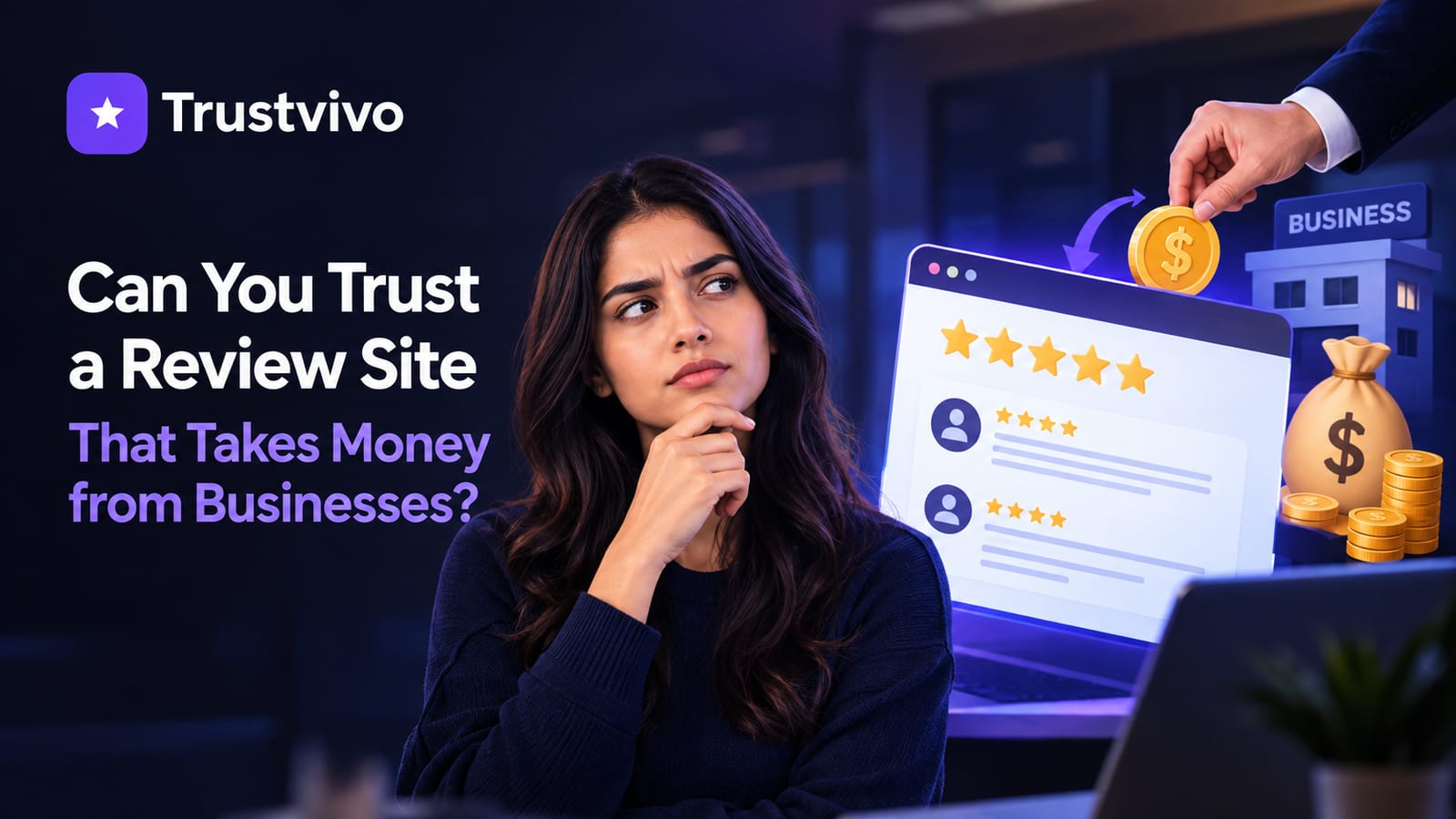
Before you trust a star rating, ask one boring question: who pays for this website to exist?
A review site looks like a public scoreboard. Customers vote with their experiences, and businesses show up with whatever they earned. But servers, fraud checks, moderators and salaries cost money, and that money comes from somewhere. Where it comes from decides which pressures sit behind the stars you read. It is the most useful thing a shopper can check in thirty seconds.
This is not a takedown. Done honestly, review platforms are one of the better consumer-protection inventions of the internet. “Done honestly” is the hard part, so here is how the money actually flows, and how to tell the honest platforms from the ones that only say they are.
The short version
Most review sites are paid by the businesses they list. That alone is not the problem. The problem starts when the payment changes what you see, instead of changing what the business can do with what you see.
- A business paying for a dashboard, reply tools or a widget: fine.
- A business paying to have a bad review hidden, “archived” or pushed down: not a review site any more.
Every question below is a way of finding out which of the two you are looking at.
How review sites actually make money
Strip off the branding, and almost every platform sits in one of five buckets. Many mix two.
| Revenue model | Who pays | Pressure on the ratings you see | Real example |
|---|---|---|---|
| Subscriptions for claimed profiles | Businesses | Low, if plans buy tools and not outcomes | Trustpilot describes itself as a business-to-business subscription company. Trustvivo works this way too. |
| Advertising | Businesses | Medium. Advertisers are the customers | Yelp’s 2025 annual filing says advertising brought in 95% of its revenue. |
| Pay-to-rank placement | Businesses | High for “Top 10” lists, often low for the individual ratings | Many software comparison sites. See Capterra’s paid placement and GoodFirms-style badges. |
| Lead-generation fees | Businesses, per lead or call | High. Every listed business has to look attractive | Local directories. See Justdial. |
| Consumer-side money (data, paid tools) | Shoppers | Different problem: what happens to your data | Rare for review sites, common for comparison apps |
1. Subscriptions for claimed profiles
This is the most common model and the most misunderstood. A bank, a retailer or a software vendor finds customers are already reviewing it. The platform then sells it a plan to claim the profile, reply to reviews, see analytics and carry a verified badge.
In a well-run version, the fee does not buy a higher rating, does not buy deletion on request and does not buy a better place in the rankings. It buys tools laid on top of reviews that customers wrote for free.
Trustpilot’s own annual reports describe this: businesses can engage on the platform for free, and it also sells paid subscription modules. Trustvivo does the same. Our pricing page has a Free plan at $0 (claim the profile, reply to every review, basic analytics), a Growth plan at $99 a month billed yearly (automated invitations, widgets, sentiment insights) and a custom Enterprise plan. Prices are in USD, and monthly billing costs 20% more.
The catch is that “pay for tools” and “pay for outcomes” look identical from outside unless the platform spells the difference out in public. Plenty blur it on purpose.
2. Advertising
Display or sponsored-content ads sold at the platform level. The link between one advertiser and one rating is weak, but the pressure is real. Yelp is the clearest public case, because as a listed company it has to say it. Its 2025 annual filing says advertising contributes 95% of revenue, and also says reviews pass through automated software that decided about 76% of submitted reviews should be recommended. About 15% were not recommended and sit on a secondary page without counting toward the star rating, and about 9% were removed. The filing says no employee, business owner or reviewer can override the software for an individual business.
You do not have to believe any of that on faith. But look at what it shows: the fight is not over a single paid deletion. It is over the big pile of reviews a platform decides not to show you, and how clearly it explains why. That is a rule you can look for on any site.
3. Pay-to-rank placement
Most visible in business-software categories. A platform builds a “Top 10” for project-management tools, and companies pay to appear, or to appear higher. Sometimes there is a small “sponsored” tag. Sometimes it is dressed up as an “editor’s score” that tracks ad spend suspiciously well.
This is not automatically fraud. Plenty of sites label sponsored slots clearly. But a “best of” list is often an advertising product in editorial clothing, while the star ratings on the individual profiles can be perfectly honest. Judge the list and the ratings separately.
4. Lead-generation fees
Common in local-services directories. A business pays per lead, click or call. The reviews may be untouched, but the platform’s income now depends on the number of paying businesses, so it has little reason to show you the sharp differences between a good one and a mediocre one.
5. Consumer-side money
Rare for pure review sites, more common for comparison tools. It removes the business-pays conflict and brings in another question: what is done with the data you hand over while researching a purchase?
So are review platforms biased?
Some are, by design, and some are not. The homepage almost never tells you which. Bias gets in by three routes.
Pay-for-removal. The clearest red flag. If a sales team will make a genuine negative review “go away” in exchange for a bigger plan, the product is reputation laundering, not reviews. A rating system exists to surface what a business would rather you did not see.
Selective solicitation. The subtle one. A business invites only the customers it knows are happy: right after a good call, right after a refund. Nobody paid to delete anything, yet the average is inflated. A platform that does not guard against it hosts a skewed picture without taking a rupee for it.
This one matters for us, so we will be direct. Our paid Growth plan includes automated review invitations. That is exactly the tool that could be used to cherry-pick. Our rule, stated on the For Businesses page, is that selective inviting designed to bias a score breaks our guidelines. Whether our detection catches it well is something we will have to show with numbers (more on that below), not something we can just claim.
Category-level conflicts. A platform that earns most of its money from one sector, say insurance, has a structural reason to keep that whole sector comfortable, even if no single insurer pays to suppress anything. It shows up less as fake five-star reviews and more as silence: the investigation never written, the “top insurers” roundup that reads like a client list.
What the law now says
This changed a lot in the last two years, and most articles on the topic still describe the old world.
- United States. The FTC’s final rule on reviews and testimonials, announced on 14 August 2024 and in force from October 2024, bans selling or buying fake reviews, buying positive or negative reviews, and insiders posting reviews without disclosing the link. It also bans review suppression, meaning baseless legal threats, intimidation or false public accusations to block a negative review, and claiming a site’s review section represents all or most reviews when low ratings were held back. A business that runs a site and calls it independent while reviewing its own products is also covered. The FTC can seek civil penalties against knowing violators.
- United Kingdom. Since 6 April 2025 the Digital Markets, Competition and Consumers Act bans fake reviews, including hosting reviews without taking reasonable steps to check they are genuine.
- India. There is no single review-site regulator. The Consumer Protection Act, 2019 can reach deceptive practices, and the Bureau of Indian Standards issued IS 19000:2022 for online consumer reviews. That standard is voluntary. It covers things like limiting duplicate reviews from one email and marking incentivised reviews separately. Check the Department of Consumer Affairs for any change in its status.
The point for a shopper: the law now explicitly covers hiding reviews, not only faking them. That makes “does this platform say what it removes and why” a fair question to ask of any site.
Five questions that separate honest platforms from rigged ones
Do not try to judge a business model from a distance. Look for a trust, methodology or about page and check these.
- Can a business pay to remove a genuine negative review? If yes, or if the answer is vague, discount every rating on that platform for that category. This is disqualifying.
- Are sponsored rankings labelled as sponsored? A “Top 10” with no disclosure is a marketing page.
- Does it publish how reviews are verified? Purchase badges, ID checks and device or IP fraud detection mean the platform spends money protecting ratings, not only collecting volume.
- Does it show the full rating and total count, or only a highlight reel? Selective display on a company’s own site is normal. On a supposedly neutral review platform it is a warning.
- Who handles disputes, and is the process public? A business should be able to flag a review as fraudulent and have it judged against clear criteria, with no way to pay for the result.
A five-minute test you can run yourself
- Find the platform’s pricing page for businesses. Read every line of the top plan. Words like “reputation management”, “review archiving” or “extended review” with no stated criteria are a flag.
- Search the platform’s name with “remove negative review”. Read what business forums and sales pages say, not only the platform’s own help page.
- Open a big brand with thousands of reviews and sort by lowest rating. Honest platforms show plenty of one-star reviews, with specific stories.
- Check whether businesses reply, and how. A flood of near-identical copy-paste replies tells you the profile is run for show.
- Look for a transparency report with real numbers: how many reviews were removed, how many appeals were upheld. No numbers usually means no tracking.
What “pay for tools, not outcomes” looks like in practice
Scenario A: legitimate. A mid-sized bank claims its profile. The plan gives it a dashboard of review volume by month, keyword trends (“wait time”, “app crashes”, “loan approval delay”), public replies and a verified badge. None of it changes a star. A genuine one-star review about a branch stays at one star indefinitely. The bank’s only lever is a public reply, which every future reader can see, so it carries its own accountability.
Scenario B: compromised. A rival platform’s “premium” tier includes a line item, sometimes worded as “reputation management”, that lets a set number of reviews a month be “archived” or “flagged for extended review” on the business’s request, with no independent check of whether the review breaks any rule. That is a paid removal button with a compliance label. The tell is in the fine print: does removal need evidence of a policy violation, or only a support ticket and an active subscription?
If you cannot find a public, specific answer to “what exactly gets a review removed here”, treat the vagueness as the answer. Deliberately fuzzy dispute rules protect a paid-removal option far more often than they protect victims of fake reviews.
Why even honest platforms drift
Bias survives on platforms that do not intend it, mostly because of scale. A site hosting tens of thousands of businesses cannot adjudicate every dispute with full context.
Under-resourced moderation takes the easy path. When the support team is behind, the fastest way to close a ticket is to side with whoever is more persistent or more valuable to the platform. That tends to be the paying business, even though nobody decided to favour advertisers.
Fraud detection is uneven. A model trained mostly on e-commerce reviews can miss manipulation in local services or finance, where genuine language varies more by region. The result is a platform that is not equally reliable in every category it covers. Keep that in mind before you assume the same trust level for a restaurant and an insurer on the same site.
How platform types compare for a shopper in India
Each type has its own weak spot.
- General consumer review platforms earn from business subscriptions and sometimes sponsored placements. Watch pay-for-removal policies and “best of” lists. If you are comparing them, our piece on why Indian shoppers are leaving Trustpilot looks at one big example.
- B2B software review sites lean on lead fees and sponsored ranking. Treat leaderboards with suspicion even when single ratings are fine.
- Local directories earn from leads and ads, so every listing is nudged to look decent. See Justdial and MouthShut.
- Employer review sites earn from recruiting and employer-branding products, which can tilt featured content positive. See our Glassdoor piece.
None of this means avoid them. It means putting less weight on curated, ranked or “featured” content and more on raw, filterable individual reviews, which are harder to monetise into bias whatever the business model.
How Trustvivo approaches this
We cannot pretend a review platform runs for free, and we are one of the platforms this article is about. Trustvivo makes its money from the first bucket: subscription tools for claimed business profiles.
The rules we hold ourselves to are on the Trust & transparency page:
- No plan at any price removes, hides or reorders reviews. Free, Growth and Enterprise all see exactly the same moderation and the same rankings.
- Removal is for guideline violations only: fabrication, spam, harassment and conflicts of interest. Never for being negative.
- A business can reply publicly to any review and can flag one it believes is fake. A human moderator judges it on evidence, and both the reviewer and the business can appeal.
- No selling of placement inside our comparison content. The businesses in our roundups on insurance or banking are there because of review volume and rating performance, not an invoice.
One honest caveat. Our promise to publish removal counts, warnings and our own false-positive rate starts once there is a real year of moderation to report. We are not there yet, so we have no numbers to show you, and you should treat our rules as claims until we do. The How it works page shows the five stages every review goes through in the meantime.
The bottom line
“How do review sites make money” is not a gotcha. It is the first diligence question for any source you are about to rely on for a purchase that matters. Almost every platform makes its money somehow, and that is fine. What matters is whether the money changes what you see, or only changes what a business can do about what you see. Once you can tell the two apart, star ratings become useful again, and so does a 90-second check of any single review.
Frequently asked questions
Do businesses pay review sites to get better ratings?
On honest platforms, no. A subscription pays for tools such as replying to reviews, invitations, widgets and analytics. It does not pay for stars. The warning sign is a platform that has no public rule saying paid plans cannot remove or reorder reviews. Trustvivo's rule is on its Trust page: no plan at any price removes, hides or reorders a review.
How does Trustpilot make money?
Trustpilot says it runs a business-to-business subscription model. Businesses can claim a profile and reply to reviews for free, and paid plans add extra modules and tools. Readers do not pay. That is the same broad model as Trustvivo, which is why the useful question is what each paid plan is allowed to do to a review, not whether money is involved.
How does Yelp make money, and does that bias reviews?
Yelp's 2025 annual filing says advertising brought in 95% of its revenue. The same filing says about 76% of submitted reviews were recommended by its software, about 15% were not recommended, and that no employee, business owner or reviewer can override the software's decision. Advertising income is a real conflict of interest, which is why checking how a platform handles the not-recommended pile matters.
Is it illegal for companies to pay for reviews?
Rewarding a customer for a review is not automatically illegal if the reward is disclosed and does not depend on what the review says. Buying fake reviews, or buying positive or negative reviews, is banned under the US FTC rule that took effect in October 2024. Since 6 April 2025 the UK's DMCC Act also bans fake reviews and hosting reviews without reasonable steps to check they are genuine.
Are review platforms regulated in India?
There is no single regulator for review sites. Fake reviews and deceptive practices can fall under the Consumer Protection Act, 2019. The Bureau of Indian Standards also published IS 19000:2022 for online consumer reviews in late 2022, but it is a voluntary standard, not a law. ASCI guidelines cover undisclosed paid endorsements. Check the Department of Consumer Affairs and BIS sites for the latest status.
How can I tell if a "Top 10" list is sponsored?
Look for a label such as sponsored, advertisement or paid placement near the list. Check whether the site publishes how it ranks. Be wary if every entry is a well-known advertiser and no criteria are shown for the order.
What is the difference between a verified review and a regular one?
A verified review means the platform checked that the reviewer had a real transaction or account link with the business, for example through an order ID or an invitation reference. It lowers the chance of a fake or a competitor attack. It does not remove it, and it says nothing about whether the sample of invited customers was fair.
Can a business legally remove a bad review about itself?
A business can ask a platform to remove a review that breaks the platform's stated rules, such as harassment, no real relationship with the business, or a false statement of fact, and it can send evidence. It cannot honestly buy the removal of a truthful, rule-following negative review. A platform that sells that has stopped being a review site.