Justdial Finds the Business. It Doesn't Tell You If They're Any Good — Here's What Does
Justdial is a local search directory, not a verified review platform. Here's the real difference between finding a business and knowing whether to trust it, and what to check before you book or buy.
· Trustvivo Editorial Team
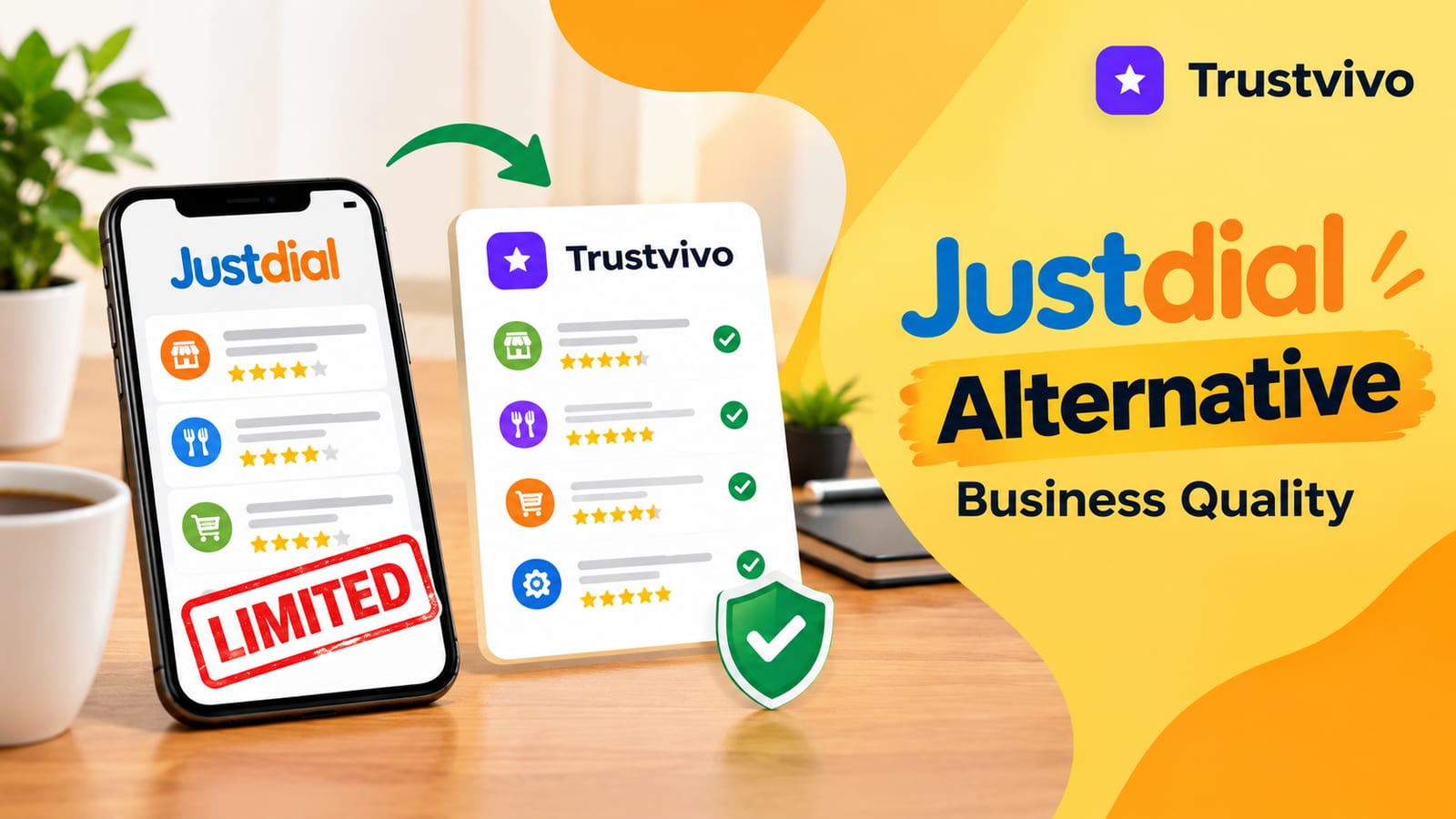
Justdial has been a fixture of Indian local search since 1996, when it started as a phone-based service connecting users to local businesses and has since grown into a platform with tens of millions of business listings and a large monthly user base. In 2021, Reliance Retail Ventures acquired a majority stake, cementing its position as one of India’s largest local business directories. If you need to find a plumber, a restaurant, or a clinic near you, Justdial is genuinely good at that job — it was built for exactly that purpose. But finding a business and knowing whether that business is any good are two different problems, and it’s worth being clear-eyed about which one Justdial is actually optimized to solve.
What Justdial does well
Justdial’s core strength is discovery and lead generation. It has an extensive database of business listings across categories and locations, a search experience that’s fast and familiar to Indian users, and a business model built around connecting consumers to service providers efficiently — including phone-based search for users who prefer that over an app. For the specific task of “find me a business that does X near me,” it’s a genuinely useful and well-established tool.
Why “found” isn’t the same as “vetted”
Justdial’s business model — a freemium structure where basic listings are free but businesses pay for premium visibility, lead-generation tools, and verified leads — means the platform’s core incentive is optimized around connecting users to businesses and generating leads for paying advertisers, not primarily around building the deepest possible verified-review layer on top of every listing. Ratings and reviews exist on the platform, but they sit alongside — and are secondary to — its core directory and lead-generation function. That’s not a criticism of the model (our guide to how review sites make money shows where lead-generation fees sit among the other revenue models); directories and review platforms solve different problems and can both be useful. But it does mean a rating you see on a directory-first platform deserves a different level of scrutiny than one from a platform whose entire design purpose is verified customer feedback.
What actually tells you if a business is good
Verified transaction proof
The single most useful signal on any review is whether the platform can confirm the reviewer actually interacted with or paid for the business’s service — not just that they created an account and left a rating.
Review recency and volume within the specific service you need
A business with a strong overall rating built mostly from years-old reviews, or from a different service line than the one you’re booking, tells you less than a handful of recent reviews specific to what you’re actually about to book.
How the business handles negative feedback
Whether a business responds to critical reviews, and whether those issues appear to get resolved, is often a more useful signal than the star average itself — it shows you how the business behaves when something goes wrong, which is exactly the scenario you’re trying to protect yourself against.
Consistency across more than one source
If a business looks strong on a directory but its actual review sentiment (where verifiable) is much thinner or more mixed on a platform built specifically for review verification, that gap is worth noticing before you commit.
A practical approach: use both, for what each is good at
The most efficient approach isn’t choosing one platform over the other — it’s using each for what it’s actually built for. Use a local search directory like Justdial to find and shortlist businesses quickly by category and location. Then, before committing — especially for higher-stakes decisions like an insurance purchase, a large service booking, or a financial product — cross-check that shortlist against a platform whose core design purpose is verified, transaction-backed review collection, where you can see recency, business responses, and a moderation approach built specifically around review authenticity rather than around lead generation.
Why the directory-vs-review distinction is easy to miss
Most users don’t consciously separate “I’m using this to find a business” from “I’m using this to decide if the business is trustworthy” — the two blur together in a single search session, especially on mobile where you’re scrolling through a results list that shows a name, a distance, a category, and a star rating all in the same glance. That compressed presentation is efficient for discovery, but it also means the star rating gets absorbed as a trust signal almost automatically, without a pause to ask how that number was actually generated or how recently it was updated. This isn’t a flaw unique to any one directory — it’s a general pattern in how any search-and-discovery interface presents ratings alongside listings, and it’s worth being deliberately aware of the habit in yourself as a user.
A concrete example of where the gap shows up
Consider booking a home appliance repair technician. A local search directory will very efficiently surface five or six technicians near you, sorted by distance and category match, each with a star rating visible at a glance. That’s the discovery job done well. But the technician’s rating on that directory might be built from a mix of reviews tied to different service types (installation versus repair versus AMC visits), from years-old jobs, with no visible confirmation that reviewers actually booked through the platform rather than just knowing the technician personally. None of that is necessarily wrong or dishonest on the platform’s part — it’s simply a byproduct of a system optimized primarily for fast discovery and lead volume rather than for review-by-review verification depth.
Now compare that to checking the same technician on a platform built specifically around verified customer reviews, where you can see that three of the five most recent reviews are tied to a confirmed booking made through the app within the last two months, each describing the specific type of repair performed. That’s a different — and for a booking decision, more useful — kind of signal, even if the aggregate star rating looks similar on paper.
Practical steps before you book based on any local search result
1. Note the category-specific rating, not just the business’s overall score. A restaurant with a strong general rating might have thinner or more mixed feedback specifically for delivery versus dine-in — check the segment relevant to what you’re about to do.
2. Scan for review dates before committing to anything non-trivial, like a larger service booking or a repeat contract (an AMC, a long-term rental, a bulk order).
3. For anything above routine, low-stakes spending, do a second check on a platform whose core design purpose is verified review collection, particularly for financial products, insurance, or larger home services where the cost of a bad outcome is meaningfully higher than a mediocre meal.
4. Ask the business directly for a couple of recent references if the booking is significant — this remains one of the most reliable verification steps available, independent of any platform’s rating system.
The honest takeaway
Justdial earned its place as India’s dominant local search directory by solving the discovery problem well for nearly three decades. That’s a real and useful function. But discovery and trust verification are different jobs, and a platform optimized primarily for the first shouldn’t be assumed to deliver the same rigor on the second. When the decision matters — and not just “which restaurant is closest” — pair a directory search with a platform built specifically to verify that the reviews behind a business’s rating reflect real, recent, resolved customer experiences.
Frequently asked questions
Is Justdial a review platform?
Justdial is primarily a local search and business directory — founded in 1996, it helps users find contact details, addresses, and listings for businesses by category and location, with ratings and reviews as a feature alongside its core search and lead-generation function, rather than being its primary purpose.
How does Justdial make money?
Justdial operates on a freemium model: basic business listings are free, while businesses pay subscription fees for premium visibility, lead-generation tools, and verified customer leads generated through the platform.
What's the difference between a business directory and a review platform?
A directory's core job is helping you find and contact a business — search, filter, discover. A review platform's core job is helping you evaluate whether that business is trustworthy, through verified customer feedback. Many platforms do a bit of both, but the primary design intent shapes which function gets more investment and rigor.
Should I trust the ratings I see on a local search directory?
Treat them as one data point rather than the full picture. Cross-check with a platform whose primary design purpose is verified review collection, especially for higher-stakes purchases like insurance, financial products, or larger service bookings.
Who owns Justdial now?
Reliance Retail Ventures Ltd. acquired a 66.95% stake in Justdial in 2021.