Your Complaint Isn't Being Ignored — You're Just Filing It in the Wrong Place: A Step-by-Step Guide
Most consumer complaints in India stall because they are filed at the wrong stage or in the wrong forum. Here is the order that works: the company, the 1915 helpline, then e-Jagriti, with current fees, limits and deadlines.
· Trustvivo Editorial Team
Almost everyone who has had a faulty appliance, a refund that never came or a bank charge nobody would reverse has had the same experience. You complain, you get a ticket number, and then nothing happens for weeks. It is easy to decide that nobody is listening.
In most of these cases somebody is listening. The complaint just went into a queue that was never built to settle it: a generic support inbox, a reply under an Instagram post, a call-centre ticket with no escalation behind it. The channels that can actually push a company to pay you back were never used, much like US shoppers who expect a Better Business Bureau complaint to force a refund.
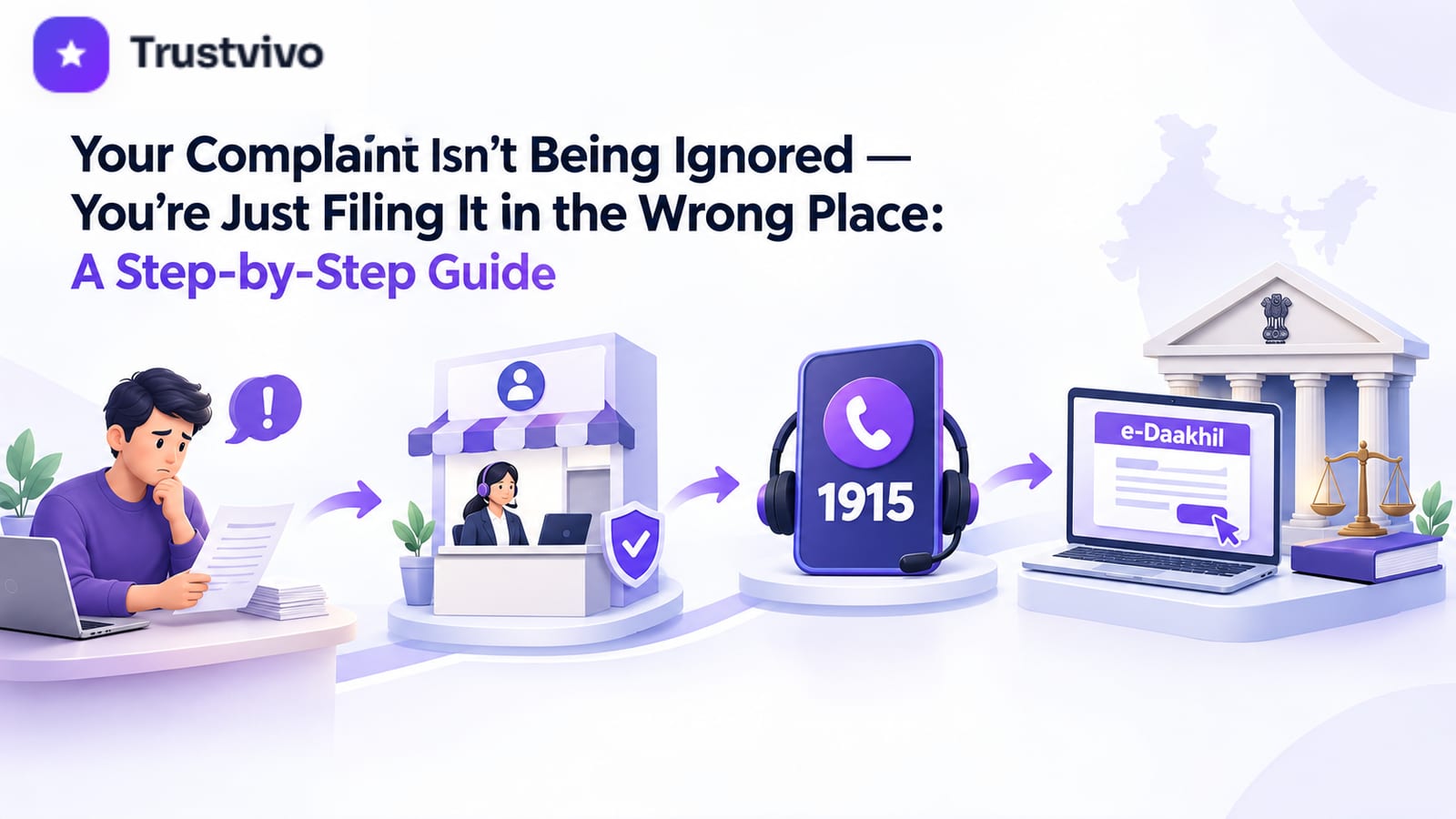
India has a clear order for this, and it is worth following in sequence. Company first, then the National Consumer Helpline, then a formal complaint to a Consumer Commission. A lot of disputes end at step one or two. This guide covers all three, plus the sector regulators that sit beside them, and it is written to the rules as they stand in November 2026.
One warning before we start. A lot of the pages that rank for this topic still describe the old system: the 1986 Act, ₹20 lakh and ₹1 crore limits, the e-Daakhil portal, fees paid by demand draft. None of that is current. If you have read advice that uses those numbers, ignore the numbers.
The route at a glance
| Step | Where | Cost | What it does |
|---|---|---|---|
| 1 | The business, in writing | Free | Creates the paper trail every later step asks for |
| 2 | National Consumer Helpline, 1915 | Free | Forwards your complaint to the company and tracks the reply |
| 3 | e-Jagriti, to a Consumer Commission | Nil to ₹7,500 by claim value | A legal complaint that can end in an order |
| Beside these | Sector regulators (RBI, insurance, telecom, e-commerce) | Free | Often faster for banking, insurance and telecom disputes |
Step 1: Complain to the business, in writing
How you do this matters more than people expect. A phone call with no reference number, or a comment on the brand’s social page, leaves nothing you can show anyone later. Send an email, or use the company’s complaint form and save the confirmation. Include:
- Your order, policy or account number
- What went wrong, with dates
- The exact fix you want: a refund of a stated amount, a replacement, a corrected bill. “Please help” gives them nothing to say yes to.
- A deadline. Seven to fifteen days is normal.
Online sellers have a legal duty here. Under the Consumer Protection (E-Commerce) Rules, 2020, an e-commerce platform must name a grievance officer, acknowledge your complaint within 48 hours and resolve it within one month. If a marketplace has done neither, you can say so in your next message, and it carries weight.
Keep screenshots of chat support and note any call reference numbers. Every later step starts with the same question: what did the company say when you told it?
Do you need to send a formal legal notice first? It is not something the Act makes a condition of filing, whatever some law-firm pages claim. But a clear written complaint plays the same role, and it is free.
Step 2: Use the National Consumer Helpline before you file anything formal
This is the step most people skip, and it is often the quickest route to getting your money back.
The National Consumer Helpline (NCH) is run by the Department of Consumer Affairs. It is not a court and cannot order anyone to pay you. What it does is route your complaint to the company through a central system called INGRAM, give you a docket number, and let you track the response online. Companies, banks, insurers, regulators and ombudsmen have signed up as “convergence partners”, so your complaint lands with a named person on the company’s side rather than in a general inbox.
How to reach it:
- Call 1915 or 1800-11-4000. The line is staffed from 8 AM to 8 PM, seven days a week except national holidays, in 17 languages, with a call-back service between 8 PM and 8 AM. (You will see “24/7” on older pages. The Department’s own page says 8 to 8.)
- WhatsApp or SMS on 8800001915. On WhatsApp you pick your state, city, sector, grievance category and company name, describe the problem, upload documents and get a docket number at the end.
- consumerhelpline.gov.in, the NCH app or the UMANG app, if you would rather type than talk.
- Email [email protected].
Does it work? The Department has published figures, and they are worth reading with the usual caution about official numbers. Press reports of its December 2025 release say the helpline resolved 67,265 refund-related grievances across 31 sectors between April and December 2025 and helped recover about ₹45 crore. E-commerce accounted for the bulk of both: 39,965 grievances and ₹32 crore. The same reports say the number of partner companies grew from 263 in 2017 to over 1,100 by late 2025.
Read that for what it is. It shows the helpline is good at refunds from companies that are already on the platform, especially online sellers. It tells you less about a contested claim for compensation, or about a small business that never signed up. If a company ignores the helpline too, you have lost nothing and you now hold a docket number to quote in your formal complaint.
Step 3: File a formal complaint on e-Jagriti
If the company has not fixed things and the helpline has not settled it, the next stop is a Consumer Disputes Redressal Commission. You do this online, on e-Jagriti (e-jagriti.gov.in).
e-Jagriti replaced e-Daakhil on 1 January 2025. It brought e-Daakhil and the commissions’ older case-management systems (OCMS, the NCDRC case system and CONFONET) into one portal, and it is meant to cover the National, State, Circuit Bench and District Commissions across the country. A November 2025 news report put registered users at more than 2.75 lakh in its first year. If you find a guide that sends you to edaakhil.nic.in, it was written before the switch.
On the portal you can file the complaint, pay the fee through the payment gateway, follow your case on a dashboard, and attend hearings by video where the Commission allows it. Physical filing at the Commission’s registry has not been abolished, but there is no good reason to travel for a straightforward complaint.
What you do on the portal
- Register with your mobile number and email and confirm the OTP. Use one login for the whole case.
- Start a new consumer complaint and select your State and the District Commission that has jurisdiction.
- Enter the parties. For the company, use its full legal name and registered office address. A vague or wrong address is one of the commonest reasons a notice never reaches the other side.
- Upload your complaint with a short index of your documents and a signed verification (affidavit) that the contents are true.
- Attach evidence as clear PDFs: bills, receipts, payment proof, emails, chat screenshots, warranty cards, your written complaint from step 1 and the company’s reply.
- Pay the fee online and submit. Note the case number it gives you.
The Commission then sends notice to the company, which gets a set period to reply in writing.
Which Commission? It depends on what you paid
Under the Consumer Protection Act, 2019, the forum is chosen by the value of the goods or services paid as consideration. Not by the compensation you want, which was the old test under the 1986 Act and still trips people up. The current limits come from the 2021 jurisdiction rules:
| Commission | Value of goods or services paid |
|---|---|
| District Commission | Up to ₹50 lakh |
| State Commission | Above ₹50 lakh, up to ₹2 crore |
| National Commission (NCDRC), New Delhi | Above ₹2 crore |
Asking for ₹10 lakh in compensation for a ₹40,000 phone does not make it a ₹10 lakh case. It stays in the District Commission, and the fee is worked out on the ₹40,000.
The 2019 Act also made life easier on location. You can file at the District Commission where the company has its office or branch, where the cause of action arose, or where you live or personally work. Before 2019 you generally had to go where the business was. Filing near your own home is now the sensible default.
What it costs
The fee depends on the same “amount paid” figure. This is the schedule in the Consumer Protection (Consumer Disputes Redressal Commissions) Rules, 2020, as substituted in August 2023:
| Value of goods or services paid | Fee |
|---|---|
| Up to ₹5 lakh | Nil |
| Above ₹5 lakh, up to ₹10 lakh | ₹200 |
| Above ₹10 lakh, up to ₹20 lakh | ₹400 |
| Above ₹20 lakh, up to ₹50 lakh | ₹1,000 |
| Above ₹50 lakh, up to ₹1 crore | ₹2,000 |
| Above ₹1 crore, up to ₹2 crore | ₹2,500 |
| Above ₹2 crore, up to ₹4 crore | ₹3,000 |
| Above ₹4 crore, up to ₹6 crore | ₹4,000 |
| Above ₹6 crore, up to ₹8 crore | ₹5,000 |
| Above ₹8 crore, up to ₹10 crore | ₹6,000 |
| Above ₹10 crore | ₹7,500 |
So for nearly every household dispute (a phone, a fridge, a holiday package, an insurance claim under ₹5 lakh), filing is free. Rules can change, so the portal shows the amount due before you pay. If it differs from this table, go by the portal.
Court fees are only part of the cost. If you hire a lawyer, that is a separate bill, and travel and printing add up if you attend in person. For a small claim, ask yourself honestly whether the likely refund beats what you will spend in time and money. For many people the answer is still yes, because the company knows you are serious. Sometimes it is no, and the helpline and the sector regulators were the right place to stop.
The two-year deadline
A Commission cannot admit a complaint filed more than two years after the cause of action arose (Section 69). It can allow a late complaint only if you explain the delay and it records that your reason was sufficient in writing. Do not plan on that. Write the date the problem began at the top of your timeline, and count two years from there. For a defect that first showed up in month ten of a one-year warranty, the clock started in month ten, not the day you bought the thing.
What to expect after you file
A Commission is meant to be quicker and less formal than a civil court, but quick is relative. A realistic picture:
- Admission. The Commission decides whether your complaint can be admitted. The Act sets a short window for this, about three weeks, though in busy commissions it can take longer in practice.
- Notice and reply. The company is served and has a fixed time to file its written version. Delays in service are the main reason early hearings get adjourned, which is why the address matters.
- Mediation. The Act lets a Commission send a case to mediation if both sides agree. If the company is open to settling, this is a cheap way to end it with a refund and be done.
- Hearings and order. The Act says a Commission should decide a case within three months of the company receiving notice, or five months if goods need testing. Treat that as a target. Plenty of contested cases run much longer, and a busy District Commission can take over a year to reach a final order when the company fights back.
- Relief. If you win, the order can include a refund or replacement, removal of a defect, compensation for loss or mental distress, and your costs. It can also direct a company to stop an unfair trade practice. You will not get a windfall. Awards track your documented loss.
- Appeal. A District order can be appealed to the State Commission within 45 days, and a State order to the National Commission within 30 days. If the order requires the company to pay you, it must deposit half the amount before its appeal is heard, which discourages appeals filed only to stall. A National Commission order passed in its original jurisdiction can be taken to the Supreme Court within 30 days.
What helps you through all of this is dull and practical. Keep one folder, digital or paper, with every document in date order. Commissions work from the papers, and the person with the cleaner file usually looks more credible.
Who can complain, and about what
You must be a “consumer”: someone who bought goods or paid for a service for personal use. A purchase made for resale or for a commercial purpose usually falls outside the Act, so a shop owner who buys a freezer for the shop is on shakier ground than someone who buys one for the house. A complaint can be about defective goods, deficient service, unfair or restrictive trade practices (including misleading advertising and some fake-review behaviour), overcharging above the printed or agreed price, or hazardous goods and services.
If your loss came from a road accident, the Motor Accident Claims Tribunal is the right door, not a Consumer Commission.
Sector complaints: often a faster route
Several regulated sectors have a dedicated process that can beat the general commission route. It is worth trying first when your dispute fits.
Banks, NBFCs and payment apps. Complain to the bank in writing first and give it 30 days. If it rejects the complaint, answers unsatisfactorily or stays silent, you can go to the RBI Integrated Ombudsman at cms.rbi.org.in or on 14448, free and without a lawyer. The time you have to approach the Ombudsman changed for complaints filed from 1 July 2026, so read our bank complaints guide for the current window before you wait. For card problems specifically, see our credit card customer service guide.
Insurance. Start with the insurer’s grievance officer, in writing. If that fails, the Insurance Ombudsman handles policy and claim disputes up to a set value, at no cost, as a faster alternative to a commission. Our car insurance claims guide, health insurance guide and travel insurance guide show how claims actually get rejected and what filers do about it.
Telecom. Complain to your operator’s complaint centre first and keep the docket number. If it is not resolved, the operator’s appellate authority is the next stop. After that the helpline or a commission can take it.
Misleading ads, dark patterns and e-commerce violations. The Central Consumer Protection Authority (CCPA) acts against unfair trade practices at the market level. It does not settle your individual refund, so use it alongside the steps above, not instead of them. Our guides to spotting fake reviews and five fingerprints of a fake review cover the review side of that.
Product defects and warranties. If a product fails repeatedly for the same fault inside its warranty, that is deficiency in goods, not bad luck. Our guides to electronics warranty reviews and home appliance service reviews show what that looks like in practice.
Government departments and utilities. These usually have their own grievance officer or an online grievance portal. Use that first, then the helpline or a commission if the department is acting as a service provider you paid for.
Mistakes that stall complaints
Filing in the wrong forum. Picking the Commission from the compensation you want rather than the price you paid is the classic one. Check the table above before you start.
No written record. Both the helpline and the Commission will ask what you told the company. “I called three times” is weak. A dated email is strong.
A vague ask. “I want justice” cannot be granted. “A refund of ₹14,999 paid on 3 March for order 4821, for a product that arrived damaged and was never replaced after three follow-ups” can.
Waiting too long. Wait for the company to answer, but keep the two-year clock in view. People lose good cases by sitting on them.
Treating social media as a formal channel. A viral post sometimes gets a quick informal fix. It creates no obligation and no record. Use it, if at all, in addition to the written complaint.
Giving up after one silence. One unanswered email is not the end. It is the evidence for step two.
Using a stale guide. If an article tells you to file on e-Daakhil, pay by demand draft or that the District limit is ₹20 lakh, it is describing a system that no longer applies.
Where reviews help
A complaint is the last resort. The better position is not needing one. Before you pay a company, look at how it handled other people’s problems. A pattern of unresolved complaints about the exact issue you are worried about tells you a lot, and a business that answers documented problems with specifics is a safer bet. You can read the review history on Trustvivo for a company before you spend. Our trust checklist before you pay and the six-point business legitimacy check are quick ways to do that homework.
Sources
- Department of Consumer Affairs, National Consumer Helpline
- National Consumer Helpline portal
- e-Jagriti portal
- Consumer Protection (Consumer Disputes Redressal Commissions) Rules, 2020, fee table as amended in August 2023 (summary)
- Business Standard, National Consumer Helpline resolved 67,000 complaints in 2025
- RBI Complaint Management System
Frequently asked questions
What is the National Consumer Helpline number?
1915 (toll-free) or 1800-11-4000. You can also use WhatsApp or SMS on 8800001915, email [email protected], the NCH app, the UMANG app, or consumerhelpline.gov.in. Calls are answered from 8 AM to 8 PM on all seven days except national holidays, and there is a call-back facility between 8 PM and 8 AM.
Is e-Daakhil still the portal to use?
No. Since 1 January 2025, consumer complaints are filed on e-Jagriti (e-jagriti.gov.in), which absorbed e-Daakhil and the older case-management systems into one portal. Many articles still tell you to use e-Daakhil, and they are out of date.
Do I need a lawyer to file a consumer complaint in India?
No. You can file and argue your own case at the District, State or National Commission. A lawyer is worth considering for a high-value or fiercely contested claim, but an everyday refund or replacement dispute is routinely handled by the complainant.
Which consumer commission should I file in?
It depends on the value of the goods or services you paid for, not on the compensation you ask for. Up to ₹50 lakh goes to the District Commission, above ₹50 lakh up to ₹2 crore to the State Commission, and above ₹2 crore to the National Commission.
How much does it cost to file a consumer complaint?
Nothing if what you paid was ₹5 lakh or less. Above that the fee is ₹200 (up to ₹10 lakh), ₹400 (up to ₹20 lakh), ₹1,000 (up to ₹50 lakh) and ₹2,000 (up to ₹1 crore), rising to ₹7,500 for claims above ₹10 crore. The fee is paid online on e-Jagriti when you file.
How long do I have to file a consumer complaint?
Two years from the date the problem arose. A Commission can accept a late complaint only if you show a good reason for the delay and it records that reason, so treat two years as a hard deadline.
Should I contact the company first or go straight to a consumer commission?
Contact the company first, in writing, and keep every reply. Use the National Consumer Helpline as a free mediation step next. File with a Commission when the company has not fixed the problem or the helpline has not settled it.