What Actually Happens After You File a BBB Complaint (It's Not What Most Guides Say)
The BBB can't force a refund. Here is what filing a complaint really does, the day-by-day timeline, and when a chargeback, state AG or small claims works better.
· Trustvivo Editorial Team
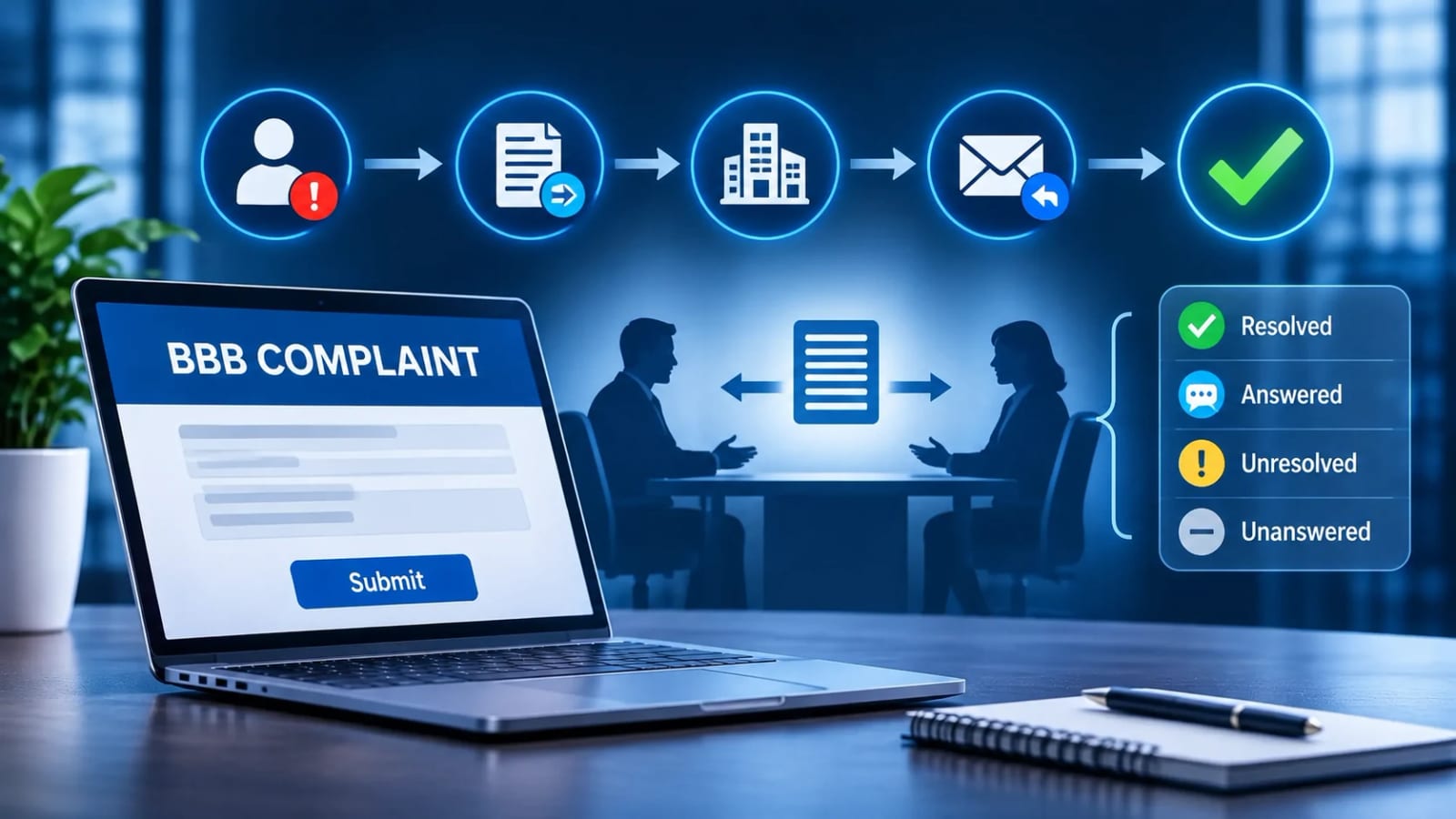
You can file a complaint with the BBB in about 15 minutes, and it costs nothing. What happens after that is where most guides go quiet. The Better Business Bureau will pass your complaint to the business, ask it to reply, and record what it does. It can’t make the business pay you, fix anything, or even answer. Its own FAQ says so in plain words: BBB “is not a government agency and holds no regulatory power,” and “we cannot force a business to act.”
That doesn’t make a BBB complaint pointless. It makes it a specific tool with a specific kind of pressure behind it, and that pressure is public, not legal. Once you see how it works, it’s much easier to decide whether filing is the right first move for your problem, or whether you’d get your money back faster through your card issuer, a state attorney general, or small claims court.
This guide covers the realistic version: what the process looks like day by day, what a business actually risks by ignoring you, the kinds of complaints the BBB turns away, and a simple decision path for choosing where to file.
How we put this guide together
Our team reads BBB business profiles every week. It’s part of how we write company reviews on Trustvivo, such as our look at what the Cleantra BBB complaints actually say and our AmeriSave Mortgage complaint breakdown. When we read those complaint records, the same pattern keeps showing up: people file expecting a refund, and they get a reply letter, or silence, instead.
For this piece, our methodology was simple. We read the BBB’s own consumer pages on 12 November 2026: the complaint filing page, the “How to complain” help page, the FAQ, and the dispute resolution page. We compared what those pages promise against what we’ve seen on dozens of closed complaints in public business profiles. For the alternatives, we used the Federal Trade Commission, the Consumer Financial Protection Bureau and USA.gov. Where a timeline or rule came from a BBB page, we say so. Where it’s our read of how things play out, we say that too.
One more thing before we start. Trustvivo is a review platform, not a law firm. Nothing here is legal advice, and rules for chargebacks and small claims vary by card network and by state.
What the BBB is, and what it isn’t
The Better Business Bureau is a private, non-profit organisation. It’s been around since 1912, it’s split into local bureaus across the US and Canada, and it’s funded largely by dues from businesses that choose to become accredited. Per the BBB’s own FAQ, “Dues paid by Accredited Businesses fund our work.”
It is not a regulator. It doesn’t license businesses, it can’t fine them, and it can’t take anyone to court. When the BBB finds a pattern it thinks is illegal, it shares that information with law enforcement and government agencies. It doesn’t act on it itself.
So when you file, you’re not opening a case. You’re asking a neutral third party to carry your complaint to the business, put the exchange on the record, and score the business partly on how it handles it.
The accreditation caveat most guides skip
Accreditation is a paid program. A business that meets the BBB’s standards can pay annual dues to display the BBB seal and be listed as “BBB Accredited.” Each local bureau sets its own dues, and they generally scale with the size of the business, so a 200-person company pays more than a 2-person one.
The BBB says accreditation “is voluntary and separate from the rating.” We’ve found that to be broadly true in practice. Plenty of non-accredited businesses hold an A+, and accredited businesses do lose ratings and accreditation. But it helps to keep the money in mind when you read a profile. A shiny seal tells you a business paid and agreed to certain standards. It doesn’t tell you how the last 50 customers were treated. For that, the complaint history is the better signal, and it’s a signal we weigh in our own 6-point check for whether a business is legit.
Step by step: how to file a complaint with the BBB
The filing itself is the easy part. Here’s how it works, with the timings the BBB publishes.
1. Contact the business first. The BBB encourages you to try the business directly at least once before you file. It isn’t a hard rule, but it helps your case. A complaint that says “I emailed on 3 October and called twice, here are the dates” reads very differently from one that skips straight to the bureau.
2. Check the business is in scope. Search for the company at bbb.org. If it has a profile, you’ll file against that profile. If it doesn’t, you can usually still file, and the BBB will try to locate the business.
3. Fill in the online form. You’ll give your contact details, the business’s details, what happened, what you paid, and, importantly, what you want. Be specific. “Refund of $480 deposit” or “replacement of the faulty part under the 12-month warranty” gives the business something to say yes to. “I want this fixed” doesn’t.
4. Attach your evidence. Receipts, contracts, order confirmations, screenshots of chat logs, photos of damage. Keep the description factual and in date order.
5. Keep personal details out of the narrative. The BBB’s help page warns that closed complaint text may be published, and that keeping personally identifiable information out of it is ultimately your responsibility. Don’t paste your account number, phone number or home address into the description box.
6. Submit. That’s it on your side, at least for now.
What happens after you file: the realistic timeline
Here is the sequence the BBB describes on its own How to complain help page, along with what tends to happen at each stage.
Day 0 to 2: your complaint goes to the business. According to the BBB, complaints are forwarded to the business within 2 business days. The business sees your name, your description and what you’ve asked for. You aren’t anonymous to them. The BBB doesn’t accept anonymous complaints at all.
Day 2 to about 15: the business is asked to respond. The help page says businesses are asked to reply within 10 to 15 calendar days. Some local bureaus quote 14 days specifically. A business that cares about its rating will usually respond inside this window. Often it’ll offer something: a refund, a partial credit, a repair visit, or an explanation of why it thinks you’re wrong.
If there’s no reply: a follow-up. If the business doesn’t answer, the BBB sends a second request. You’ll be told either way, whether the business responded or stayed silent.
When the business replies: your turn. You can accept the response, reject it, or reply with more detail. This back-and-forth can go a couple of rounds. If you reject an offer, say why and say what would settle it.
Around day 30: the complaint is closed. The BBB says complaints are generally closed within approximately 30 calendar days of filing. The closing note records how it ended: resolved, answered but not resolved to your satisfaction, or not answered at all.
After closing: it goes on the record. The complaint counts toward the business’s profile for 3 years from the filing date, per the BBB’s help page. The text of closed complaints may be published there too, along with the business’s reply.
If both sides want to keep going, some local bureaus offer formal dispute resolution: conciliation, mediation or arbitration. The BBB’s dispute resolution page says mediation and arbitration “generally take less than 40 days start to finish.” Availability varies by bureau, and the business has to agree to take part, except where a contract already commits it to BBB arbitration.
So the whole thing is usually done in a month. That’s fast compared with small claims court. But “done” doesn’t mean “paid.”
The real leverage: the public record, not a penalty
This is the part competing guides tend to blur. A BBB complaint has no legal force. Its power comes from three things a business can’t easily ignore.
The rating. The BBB grades businesses on 13 levels, from A+ down to F. According to the BBB FAQ, ratings draw on complaint history, how a business responds to complaints, how open it is about its practices, and any licensing or government action against it. Customer star reviews don’t factor in. Unanswered complaints weigh especially heavily. When we compared low-rated profiles for our reviews, failure to respond was one of the most common reasons listed. In our Cleantra review, for example, the profile listed a failure to respond to 14 complaints as one reason for its F.
The visibility. A BBB profile is a high-ranking page for most company names. Search “[company] reviews” or “[company] complaints” and the BBB profile is often on page one. A business that sells to the public knows that a run of unanswered complaints sits right there for every prospective customer to read. That’s real money to them, which is why many will settle a $200 dispute rather than leave it hanging on their profile.
The paper trail for regulators. The BBB shares complaint patterns with government agencies. A single complaint rarely triggers anything. But a business with 60 nearly identical billing complaints in 12 months is the kind of pattern state attorneys general and the FTC look at, and your complaint is part of that count.
Put plainly: you are trading on the business’s reputation. That works well against companies that care about their reputation. It works badly against those that don’t.
When a BBB complaint tends to work, and when it doesn’t
We’ve seen enough closed complaints to say this with some confidence. Filing tends to get results when:
- The business is established, sells to the public, and has a profile it clearly maintains. It’s accredited, or it has responded to past complaints.
- Your dispute is modest and concrete: a missed refund, a botched installation, a subscription that kept charging after you cancelled.
- The business has simply dropped the ball, and a formal letter is what it takes to get the right person to look.
- You’ve already tried direct contact and you have dates and documents to show it.
It tends to go nowhere when:
- The business is a fly-by-night online store, a likely scam, or a company with a long list of unanswered complaints. If it hasn’t answered the last 30, it probably won’t answer yours.
- The business is in financial trouble or has closed. The BBB won’t process complaints against businesses that are out of business.
- The amount is large enough that a reputational hit is cheaper for the business than paying you.
- Your goal is something only a court or regulator can order: damages, penalties, or a licence revoked.
If you’re not sure which group a company falls into, look at its profile before you file. If you see recent complaints marked as answered, filing is worth it. A wall of unanswered ones is your cue to go straight to a route with teeth. Our online scam checker guide covers quick checks to tell an unresponsive business from an outright fraud.
Complaints the BBB won’t accept
The BBB’s help page publishes a list of complaints it won’t process, and it’s worth checking before you spend time on the form. It includes:
- Disputes between an employer and an employee
- Complaints about the postal service, or about government agencies (unless the agency sells a commercial service)
- Complaints based only on discrimination or similar statutory or constitutional rights
- Complaints asking only for criminal penalties
- Matters already decided by a court, arbitration or a settlement
- Businesses that are no longer operating
- Collection of money you’re owed for goods or services you sold
- Complaints based only on price, or simple buyer’s remorse
- Complaints against private individuals who aren’t in business
- Anonymous complaints, or complaints that don’t ask for any help
Two of these catch people out. “Buyer’s remorse” means you changed your mind, not that the product was faulty. And “price dissatisfaction” means you feel you paid too much, not that you were charged more than agreed. An overcharge against a written quote is a valid complaint. Feeling a quote was steep is not.
A decision path: BBB, chargeback, attorney general, or small claims?
Here’s the decision path we’d walk through for a typical consumer dispute. Work down it in order, and stop at the first one that fits.
Did you pay by credit card in the last 60 days or so, and is the problem a charge you didn’t authorise, goods that never arrived, or something not as described? Start with a chargeback. Under the Fair Credit Billing Act, you generally have 60 days from the date the statement with the error was sent to dispute it in writing with your card issuer. The FTC’s guide on using credit cards and disputing charges explains the rules. A chargeback can actually move money back into your account. A BBB complaint can’t. Debit card and bank transfer protections are weaker and work differently, so check with your bank quickly if that’s how you paid.
Is it a financial product: a bank, a lender, a credit card, a mortgage servicer, a debt collector, a money transfer app? File with the CFPB at consumerfinance.gov/complaint. The CFPB forwards complaints to the company and companies generally respond within 15 days. Unlike the BBB, it’s a federal regulator, and complaint data feeds its supervision work.
Does it look like fraud, a scam, or a deceptive practice that’s probably hitting lots of people? Report it to the FTC at ReportFraud.ftc.gov, and to your state attorney general’s consumer protection office. USA.gov keeps a directory of state consumer protection offices. Many AG offices run their own mediation programs for individual complaints, and they do have enforcement power if they find a pattern. Filing with the BBB as well is fine. It adds to the public record.
Is the business real and reachable, and is the dispute modest and documented? This is where the BBB shines. File the complaint, keep the tone factual, and ask for something specific. Give it the full 30 days.
Did the BBB complaint close unresolved, and is the money worth a few hours of your time? Look at small claims court. Limits vary widely by state, from a few thousand dollars in some states up to $25,000 in others such as Delaware and Tennessee. Filing fees are usually under $100, and you normally don’t need a lawyer. A closed BBB complaint where the business refused to respond is useful evidence that you tried to settle in good faith.
Is the claim large, or does it involve injury, a contract worth tens of thousands, or a business that’s threatening you? Talk to a lawyer. Many state bar associations run referral services with low-cost first consultations.
You can stack these. A common, sensible sequence is: direct contact, then a chargeback if you paid by card, then a BBB complaint at the same time for the public record, then the AG or small claims if neither works.
Writing a BBB complaint that gets a response
Most of the complaints we read that got a quick, useful reply had the same shape. Here’s what they did well.
They led with a one-line summary. “Paid $1,250 on 4 September 2026 for a kitchen countertop install scheduled for 18 September; no installer arrived and the deposit hasn’t been refunded.” Whoever reads it at the business knows the issue in 10 seconds.
They gave a short, dated timeline. Three to six lines, each with a date. No long backstory about how much you liked the company before.
They asked for one specific outcome. A full refund of $1,250 within 14 days, or installation by a named date. If you’d accept either, say so.
They stayed calm. Insults and all-caps make it easy for a business to reply with a polite non-answer and look reasonable doing it. Remember that the public may read this later, and so might a small claims judge.
They left out private data. No account numbers, no card numbers, no home address in the free-text field.
Here’s a simple template you can adapt:
On [date], I paid [amount] to [business] for [product or service], order number [last 4 digits only]. [What went wrong, in one or two sentences.] I contacted the business on [date] by [email/phone] and on [date] by [method], and [what they said, or that they didn’t reply]. I’m asking for [specific outcome] by [date]. Copies of my receipt and messages are attached.
What to expect from the business’s reply
Responses tend to fall into a few types, and each one calls for a different next move.
A full fix. The business agrees to refund, replace or redo the work. Accept it in the BBB portal, but don’t mark it resolved until the money is actually back in your account or the work is done. If it hasn’t arrived by the date promised, reply and say so.
A partial offer. A store credit instead of cash, a 50% refund, or a repair instead of a replacement. Decide whether it’s fair. You can counter. If you accept less than you asked for, that’s your call. It’s often worth it on a small amount.
A defence. The business disagrees and explains why: you signed terms that allow the charge, the damage was caused by misuse, the delivery was confirmed. Read it carefully. Sometimes they’re right, and it’s better to learn that now than in small claims. If they’re wrong, reply once with the specific facts that contradict them, then move on to the next route on the decision path.
A form letter. A templated “we take your concerns seriously” with no actual offer. Reply asking for a specific answer to your specific request. If the second reply is also a form letter, it’ll likely close as answered but unresolved, and you’ve got a clean record to take elsewhere.
Silence. Even after the follow-up. This is a strong signal on its own. It’ll close as unanswered and count against the business’s rating, and it tells you the reputational route has no grip on this company. Go to your card issuer, the AG or small claims.
How to read other people’s BBB complaints before you buy
Filing is one half of the BBB. The other half is reading, and that’s where we’d argue it’s most useful. Before a sizable purchase, spend five minutes on the business’s profile and look at:
- Volume against size. 40 complaints against a national retailer with millions of customers is a different story from 40 against a local roofing firm.
- Response rate. Are complaints answered? A business that answers every complaint, even the ones it disputes, is engaging. One that ignores them is telling you how it’ll treat you.
- Recurring themes. One shipping complaint is noise. Twenty about the same auto-renewal is a business model.
- The trend. A sudden spike in the last 12 months can signal a change in ownership, staffing or finances.
- The rating reasons. The profile lists what pushed the grade down. Read them.
We use exactly these signals in our own trust checklist before you pay. And a quick caution about the review tab: BBB customer reviews are separate from complaints and don’t affect the rating. Like reviews anywhere, they can be gamed. Our guide on how to spot fake reviews applies to the BBB too.
Complaint, review or Scam Tracker: picking the right BBB form
The BBB site has three different ways to report a business, and people mix them up all the time. Picking the wrong one is one of the most common reasons a filing goes nowhere.
A complaint is for a dispute where you want something from the business: a refund, a repair, a cancellation, an explanation. It’s the only one of the three that the BBB forwards to the business with a request to reply, and the only one that runs on the 30-day cycle described above. It also feeds the rating.
A customer review is your opinion of the experience, good or bad, with a star score. Use it when you don’t need anything from the business and you just want other buyers to know how it went. The business can reply publicly, but there’s no mediation, and per the BBB FAQ, reviews don’t factor into the letter grade.
BBB Scam Tracker is for reporting a scam: a fake online store, a phishing text, an impostor posing as a company or a government office. It’s built to warn other people and to share data with law enforcement, not to get your money back from a legitimate business. If someone took $300 for a puppy that never existed, that’s Scam Tracker plus a report to the FTC, not a complaint. There’s no real business on the other end to forward it to.
Here’s a quick way to choose. If you want the business to do something, file a complaint. To tell other shoppers how it went, write a review. And if there’s no real business, only a person trying to steal from you, use Scam Tracker, then call your bank the same day.
It’s fine to do more than one. After a complaint closes, some people also leave a review so the outcome is visible in plain language. That’s reasonable, as long as you stick to what happened and what you can show.
If you’re a small business filing against another business
Business-to-business complaints are accepted, which surprises a lot of owners. If a supplier didn’t deliver, a marketing agency stopped answering after taking a 6-month retainer, or a software vendor kept billing after you cancelled, the same form and the same 30-day process apply. The same limits apply too: the BBB won’t chase money a customer owes you, and it can’t enforce a contract. For an unpaid invoice, a demand letter and small claims (or a collections agency) are the right tools. For a vendor who took your money and vanished, a complaint plus the card dispute route is worth doing, because the vendor’s next prospective client may read it.
Common myths about filing a complaint with the BBB
“The BBB will get my money back.” It won’t, at least not directly. It can carry your request and record the outcome. Any refund comes because the business decided to pay.
“A business that ignores the BBB gets fined.” There are no fines. The cost is a lower rating, a public record, and possibly attention from regulators if a pattern builds.
“Filing is anonymous.” It isn’t. The business sees who you are, and the BBB doesn’t accept anonymous complaints.
“Only accredited businesses get complaints.” Anyone in business can be the subject of a complaint, accredited or not, and the rating applies to both.
“An A+ means a business is safe.” An A+ means the business has handled its complaints well and hasn’t triggered the other rating factors. It’s a good sign. It’s not a guarantee about your transaction, which is why we always pair it with the other checks above.
The bottom line
File a complaint with the BBB when the business is real, reachable and cares about its public profile, when your claim is modest and well documented, and when you’ve already tried the direct route. Expect a decision inside about 30 days, and expect it to depend entirely on whether the business chooses to engage.
Don’t treat the BBB as your only move when money is on the line. If you paid by credit card, start the chargeback clock now. If it’s a financial company, the CFPB has more pull. If it smells like fraud, report it to the FTC and file a complaint with your state attorney general. And if everything else fails, small claims court is cheaper and simpler than most people think.
At Trustvivo, we read these records so you can spot the warning signs before you pay, not after. If you’re weighing up a company right now, start with its complaint history, then run our quick checks on whether it’s legit.
Frequently asked questions
Can the BBB force a business to give me a refund?
No. The BBB is a private non-profit, not a government agency, and its own FAQ says it cannot force a business to act. It forwards your complaint, asks the business to respond, and records the outcome on the business's public profile. Any refund comes because the business chooses to pay.
How long does a BBB complaint take?
The BBB forwards complaints to the business within 2 business days and asks for a reply within roughly 10 to 15 calendar days, with a follow-up if there's no answer. Most complaints are closed within about 30 calendar days of filing.
Are BBB complaints public?
Yes. A complaint counts toward the business's BBB profile for 3 years from the filing date, and the text of closed complaints, along with the business's reply, may be published. Keep account numbers, phone numbers and your address out of the description.
Can I file a BBB complaint anonymously?
No. The BBB doesn't accept anonymous complaints, and the business will see your name and the details you submit so it can look up your order or account.
What happens if the business ignores my BBB complaint?
The BBB sends a follow-up request. If the business still doesn't respond, the complaint closes as unanswered and counts against its rating. There's no fine or legal penalty, so at that point a chargeback, a state attorney general complaint or small claims court is the better route.
Should I file a BBB complaint or a credit card chargeback?
If you paid by credit card and the problem is an unauthorised charge, goods that never arrived or goods not as described, start the chargeback first. Under the Fair Credit Billing Act you generally have 60 days from the statement date to dispute in writing. You can file a BBB complaint at the same time to put the dispute on the public record.
Does a business pay to get a better BBB rating?
Businesses pay dues to become BBB Accredited, but the BBB says accreditation is voluntary and separate from the rating. The letter grade, from A+ to F, is based on complaint history, how complaints are handled, transparency and any government action.