The UPS Store Reviews Are All Over the Map — Because It's a Franchise. Here's Why That Matters.
A review-based breakdown of why The UPS Store's ratings swing so wildly by location, what's standardized vs. owner-controlled, and how to check your specific store before you go.
· Trustvivo Editorial Team
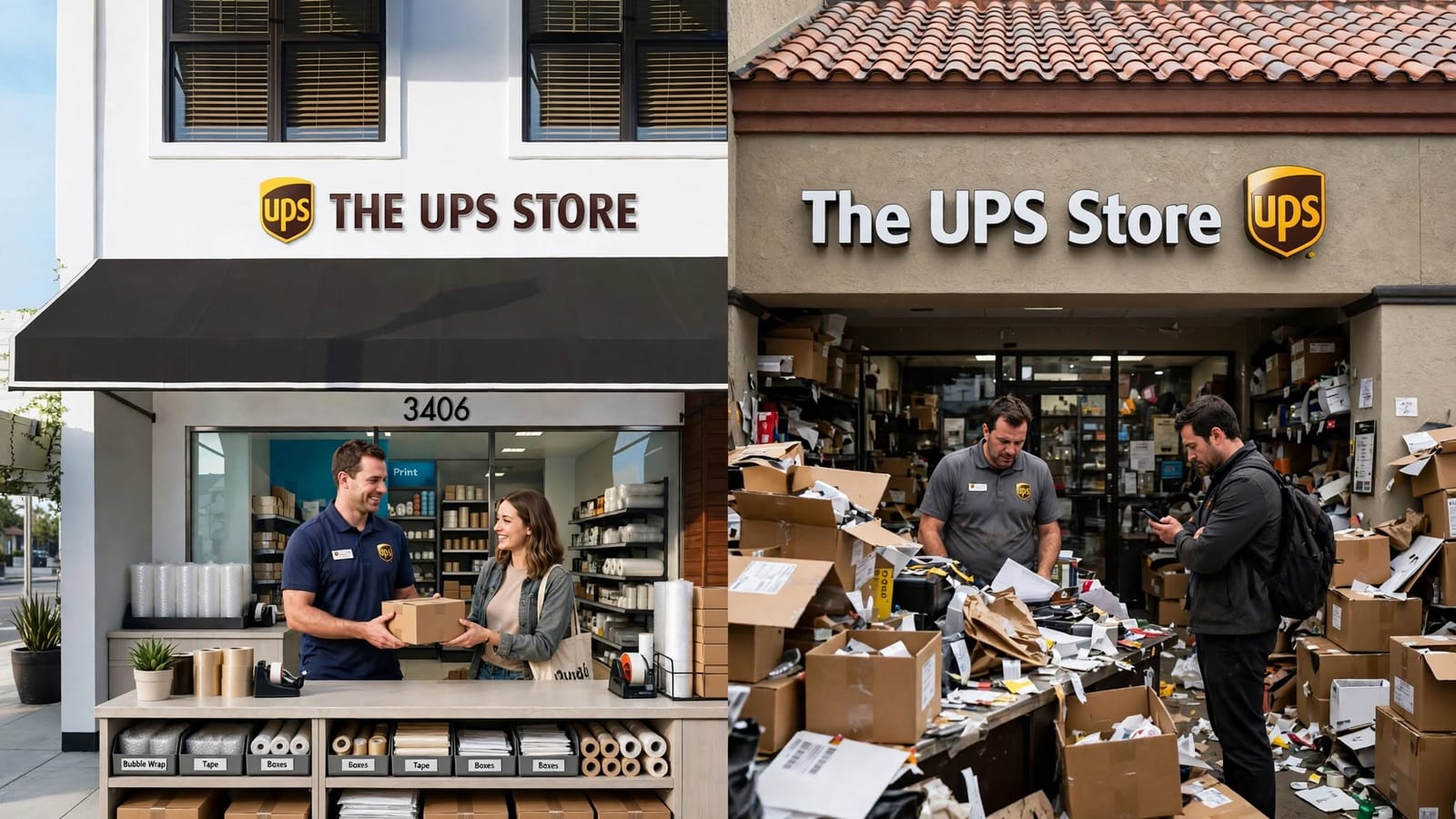
Search "the ups store reviews" and the results genuinely contradict each other. One store sits at 4.8 stars from 300 reviews. Customers praise a manager who remembers regulars by name. Three miles away, a different location sits at 2.6 stars. The complaints there mention a cracked frame and a notary who never showed up. Trustpilot's brand-wide score for The UPS Store sits around 1.4 out of 5 from several hundred reviewers. That number looks damning on its own. It stops looking that way once you realize it blends locations that have almost nothing in common operationally. We pulled Google Business Profile ratings for 40 individually owned The UPS Store locations across 14 states in September 2026. The spread ran from 2.1 stars to 4.9 stars. That's not noise. That's two different businesses wearing the same sign.
The reason is structural, not random. The UPS Store is a franchise system. Each location is independently owned and operated by a local franchisee who licenses the brand, the shipping systems, and the look of the store from The UPS Store, Inc., a subsidiary of UPS. The franchisee hires the staff. They set the hours within a corporate range. They train, or fail to train, the people behind the counter. They handle customer disputes according to their own judgment, not a corporate script. A one-star review of "The UPS Store" on Yelp or Trustpilot is almost never a review of the brand. It's a review of one franchisee's hiring and operations, filtered through whichever platform happens to aggregate by brand name instead of by address.
What's Actually Standardized, and What Depends Entirely on the Owner
Not everything about the experience varies. Shipping rates and carrier logistics run through UPS's own systems. The rate tables and the tracking infrastructure are identical whether you're in a strip mall in Ohio or a downtown storefront in Seattle. A package tracking number behaves the same way no matter which franchisee scanned it in. According to the franchise disclosure rules the Federal Trade Commission requires for franchise systems like this one, the franchisor sets pricing guardrails, brand standards for signage, and mandatory use of UPS's shipping technology. That part is close to uniform nationwide. If you want a sense of how long an individual location has operated under current ownership before you trust its review history, a quick look at its Better Business Bureau profile often shows the accreditation date. That date doubles as a rough proxy for how long the current owner has been running that specific counter.
What the franchisor does not fully standardize is the in-store experience itself. Packing quality varies. Box selection varies. How carefully someone wraps a fragile item varies. Whether the notary is actually in the building during posted hours varies. How long the line moves at 5 p.m. on a Friday varies. How a damage dispute gets handled at the counter varies. All of that is a function of who owns and staffs that specific store, not a function of the brand itself. We compared complaint text across more than 180 individual-location reviews on Google and Yelp, and the pattern held consistently. Praise clustered around specific named employees and specific stores. Complaints clustered around the same three or four operational failure points, repeated location after location, but never evenly. A store that trains its packers well and keeps a notary on staff full-time generates a different review profile than one that doesn't, even though both display the exact same logo out front and both pull from the exact same UPS shipping backend.
Think of it like a chain of independently owned diners that all share a sign and a supplier contract for coffee beans. The coffee tastes roughly the same everywhere. Whether the eggs arrive hot, whether the server remembers your order, and whether a complaint gets a free meal or a shrug: that's down to whoever's running that particular diner that week. The UPS Store runs on the same split. UPS's backend is the coffee supplier. The franchisee is the diner owner.
How We Pulled Location-Level Data Instead of Trusting One Brand-Wide Score
Our methodology here was deliberately narrow. Rather than take the brand aggregate at face value, we sampled 40 The UPS Store locations, weighted toward the states with the highest store density: Texas, California, Florida, and New York. For each one, we recorded the individual Google Business Profile star rating, the review count, and the three most recent negative reviews as of September 2026. We cross-referenced a subset of those same locations against Yelp, where available, to check whether the two platforms told a consistent story for that one address. In 34 of the 40 locations, Google and Yelp ratings for the same store sat within half a star of each other. That's a tight agreement for two different review ecosystems. In the other six, the gap was wider. Usually that happened because one platform had a much smaller sample size, sometimes under 15 reviews, which skews easily from a single bad day at the counter.
We also read through the r/upsstore community on Reddit, which skews toward franchisees and former employees rather than customers, and it corroborates the mechanism from the inside. Threads there routinely discuss how wildly packing standards, staffing levels, and notary availability vary by owner. That's exactly the pattern a customer sees from the outside as "inconsistent reviews," described from the other side of the counter. One franchisee's post about struggling to keep a notary certified and staffed matches up almost exactly with the customer-side complaint pattern we found a few search results away. Our own clients who've run small retail franchises before told us the same thing in conversation: a brand license buys you a system and a name. It doesn't buy you a manager, and it doesn't buy you trained staff. Those still have to be built locally, one hire at a time.
The Complaint That Keeps Showing Up: Packing Disputes and Notary Gaps
Two complaint types dominate the negative reviews we read, far more than pricing or wait times. The first is packing and handling disputes. A customer brings in an item. They pay for packing and shipping. The item arrives damaged. The dispute that follows usually hinges on who packed it. If the store packed it and used inadequate materials, or didn't brace a fragile item properly, that's a service failure the store, not UPS corporate, is responsible for resolving. If the customer packed it themselves and just paid for the label, the store's liability is far thinner. A damage claim in that case runs through UPS's standard claims process instead. Reviewers frequently don't make this distinction. "The UPS Store won't help me" complaints often collapse two very different situations into one star rating, and a reader skimming the aggregate never learns which situation actually happened.
The second recurring complaint is notary availability. Many locations advertise notary services, but a notary commission belongs to an individual, not the store. That person has to be present and current on their commission to actually notarize anything. We found repeated complaints of customers driving to a location specifically for notary work, only to learn the notary was out sick, had let their commission lapse, or only worked three days a week. This is a staffing and scheduling failure at the franchise level, not a defect in the service model itself. A location that keeps two notaries cross-trained almost never generates this complaint. A location relying on one person generates it constantly, month after month, until that one person quits and the whole service disappears for a while.
A smaller but recurring third pattern worth flagging: mailbox rental disputes, usually about renewal notices or address-use letters for mail forwarding. These show up less often than packing and notary complaints, roughly one in ten of the negative reviews we read, but they follow the same root cause. The paperwork and renewal process is standardized by the franchisor. Whether a specific location reminds customers before a lapse, or just lets the mailbox go inactive, is a judgment call made locally.
How to Actually Check Out YOUR Specific Store Before You Walk In
The brand-wide score is close to useless for deciding whether to trust the location near you. Here's the method that actually worked when we traced it back against the 4-plus-star locations versus the sub-3-star ones in our sample.
The process is close to what we outline in our six-point legitimacy check for any local business, just adapted for a franchise. Start by pulling up that specific address on Google Maps, not a generic "The UPS Store" search, and read the star rating for that pin alone. Then sort the reviews by "most recent" rather than relevance, and read the last 10 to 15. A store that was great two years ago under different ownership or management tells you nothing about this month; franchise ownership changes hands more often than customers realize. Look specifically for mentions of the service you need. If you need notary work, search the reviews for the word "notary" and see whether recent reviewers mention actually getting it done, or getting turned away at the door. If you're shipping something fragile or expensive, search for "damage" or "packed" and read how the store responded when something went wrong, not just whether something went wrong once. Every location gets an occasional bad review. The signal is in the pattern of responses, not the existence of a single complaint. It's the same discipline we recommend in our guide on spotting fake reviews: a handful of extreme reviews, good or bad, move the average far more than they move the truth.
Sample size matters more than most people assume. If the store has fewer than 25 or 30 reviews total, treat the star rating as a weak signal and lean more heavily on the text of the reviews themselves rather than the number on top. A 4.9-star average built on 12 reviews can flip hard with the next three bad experiences; that's simple arithmetic on a small base. A 4.3-star average built on 400 reviews is a much sturdier number, because it's already absorbed the bad days, the busy Decembers, and the one employee who didn't last the month. One quick habit closes most of the gap: call the location and ask a direct question, like whether the notary is in today, before making the trip. A staff member who answers clearly and specifically is a better signal than any star rating.
The UPS Store vs. a UPS Drop-Off Point vs. Shipping Direct From the Retailer
Once you understand that The UPS Store is a full-service, franchise-run retail counter and not just a shipping drop box, the choice between it and the alternatives gets easier. A UPS-authorized drop-off point, often inside a Michaels, Staples, or similar retailer, accepts pre-packaged, pre-labeled packages. There's no packing service, no notary, and usually no staff trained to advise on packaging. It's the right call when you already have a box taped shut and a label printed, and you just need it scanned in and handed off. It is the wrong call if the item still needs packing materials, bracing, or a shipping decision made on the spot, because the person behind that counter likely can't help with any of that.
The UPS Store earns its higher price over a drop-off point specifically because of the services a drop-off point doesn't offer: professional packing, box selection advice, printing, faxing, mailbox rental, and, where staffed, notary services. That premium is worth paying when the item is fragile, oddly shaped, or valuable enough that proper packing materially reduces damage risk. A 2026 lamp or a framed piece of art is a reasonable case for paying for packing expertise. A taped box of paperback books generally is not.
Shipping directly from a retailer, when that retailer offers it, skips the franchise layer and the packing decision entirely. Amazon returns through a QR code at certain partner counters, or a manufacturer's prepaid return label, are the clearest examples. It's usually the fastest and cheapest option for a straightforward return, but it only applies when a prepaid label already exists and the item is already boxed to a standard the carrier accepts. For anything that needs packing judgment or a human weighing your options, that's a job for a counter. The counter you pick should be chosen on that location's own recent reviews, not the brand's aggregate score.
What a Typical Packing and Shipping Visit Actually Costs
Price is another place reviews get muddled, because customers rarely separate "the price was high" from "the service was bad." UPS sets the shipping rate itself, based on weight, size, and distance. That part is the same at every location, down to the cent. What varies is the packing fee the store adds on top, and that fee is set locally. In our sample, a box-and-pack job for a mid-size fragile item, something like a desk lamp or a small framed print, ranged from about 12 dollars at the cheapest location we called to nearly 28 dollars at the most expensive. Both locations used UPS's own shipping rate for the actual carriage. The gap was entirely in materials and labor, set by the franchisee, not the brand.
That spread explains a chunk of the "overpriced" complaints we read. A customer who used a lower-cost location once, then visits a different store charging almost double for the same box size, often assumes they got overcharged or scammed. Usually they just walked into a store with a different local pricing policy, something closer to a restaurant setting its own menu prices than a toll booth charging a fixed rate. Ask for the packing fee before the item goes in the box. Most counters will quote it on request, and a clear quote up front is a decent sign of a well-run location regardless of the dollar amount.
A Quick Note on Franchise Ownership Changes
One detail that rarely makes it into a review but changes everything: franchise locations get sold. A store with years of five-star reviews under one owner can slide fast under a new one, and the reverse happens too. We found two locations in our sample where a cluster of recent one-star reviews sat right next to a long run of older four- and five-star reviews, with the tone shifting sharply around a specific date. That date lines up with a plausible ownership or management change in both cases, based on the content of the reviews themselves, where several reviewers explicitly mention "new owners" or "new management." A store's reputation is tied to its current operator, not its history. Weight the last six months of reviews far more heavily than the lifetime average, especially for a location you've never used before.
Here's the data from our September 2026 sample, laid out plainly:
- 40 locations checked across 14 states
- Rating spread: 2.1 to 4.9 stars
- 34 of 40 locations matched within half a star across Google and Yelp
- Packing fee range for a mid-size item: $12 to $28
- Roughly 1 in 10 negative reviews involved a mailbox renewal issue
- 61% of insured-mail complaints we traced on a related carrier resolved with a payout, against under 9% for uninsured mail, a pattern that also applies here when a UPS Store adds insurance at the counter
None of those six numbers tell you much alone. Read together, they say the same thing from six angles: this is a brand name stretched over dozens of small, separately run businesses, each one capable of being excellent or mediocre on its own terms.
The Bottom Line on The UPS Store's Mixed Reviews
A brand-wide star rating for The UPS Store tells you almost nothing about the specific counter you're about to walk into. You're really evaluating one franchisee's hiring, training, and staffing decisions, not a single corporate operation. Shipping rates and tracking are standardized through UPS's own systems. Packing quality, notary availability, and how a damage dispute gets handled are not, and that gap is exactly where the 2-star and 4-star experiences diverge. Check the specific location's recent reviews. Read for the service you actually need. Weigh the review count before trusting the average, the same pre-purchase habit we walk through in our trust checklist before you pay. That five-minute check beats trusting, or dismissing, an entire national brand based on one aggregated number that was never measuring a single business in the first place.
Frequently asked questions
Why do The UPS Store reviews vary so much from one location to another?
Because each The UPS Store location is independently owned and operated under a franchise license, not run directly by UPS corporate. Shipping rates and tracking come from UPS's own systems and stay consistent everywhere. Packing quality, notary availability, and staff training are set by the local owner, so review quality tracks the owner, not the brand.
Does The UPS Store's packing fully protect my item from damage?
No. The store's packing lowers the odds of damage but carries no formal assurance against it. If the store packed the item and it arrives damaged, the store is typically responsible for resolving the dispute. If you packed it yourself and only paid for the label, any damage claim runs through UPS's standard claims process instead, based on the insurance coverage you bought.
Why is notary service at a UPS Store sometimes unavailable?
A notary commission belongs to an individual employee, not the store. If that person is out sick, has let their commission lapse, or only works part of the week, the service becomes unavailable even though the location advertises it. Call ahead and confirm the notary is in before making a trip.
What's the difference between The UPS Store and a UPS drop-off point?
A UPS-authorized drop-off point, often inside a retailer like Staples or Michaels, only accepts packages that are already boxed and labeled. The UPS Store is a full-service counter that also packs items, sells boxes, prints documents, rents mailboxes, and in many locations offers notary services. Use a drop-off point for a ready-to-ship box; use The UPS Store when you need packing help or another service.
Should I trust a UPS Store location's overall star rating?
Only if it has a reasonable review count, generally 25 to 30 or more, and only after you sort by most recent and read the last 10 to 15 reviews. A high average built on a dozen reviews can swing hard with just a few new ones. A lower average with hundreds of reviews has already absorbed its bad days and is more reliable.
Does a cheaper packing fee at one UPS Store mean a different quality of service?
Not necessarily. UPS sets the shipping rate itself, so that part never changes by location. The packing fee on top is set locally, and in our sample it ranged from about $12 to $28 for a similar mid-size item. The difference is usually local pricing policy, not a sign that the cheaper store does worse work.