Reporting a Scam to the FTC Won't Get Your Money Back. Here's What It Actually Does
The FTC doesn't resolve individual complaints or recover your money. Here's what an FTC report really does, how to file one, and where to file at the same time to get money back.
· Trustvivo Editorial Team
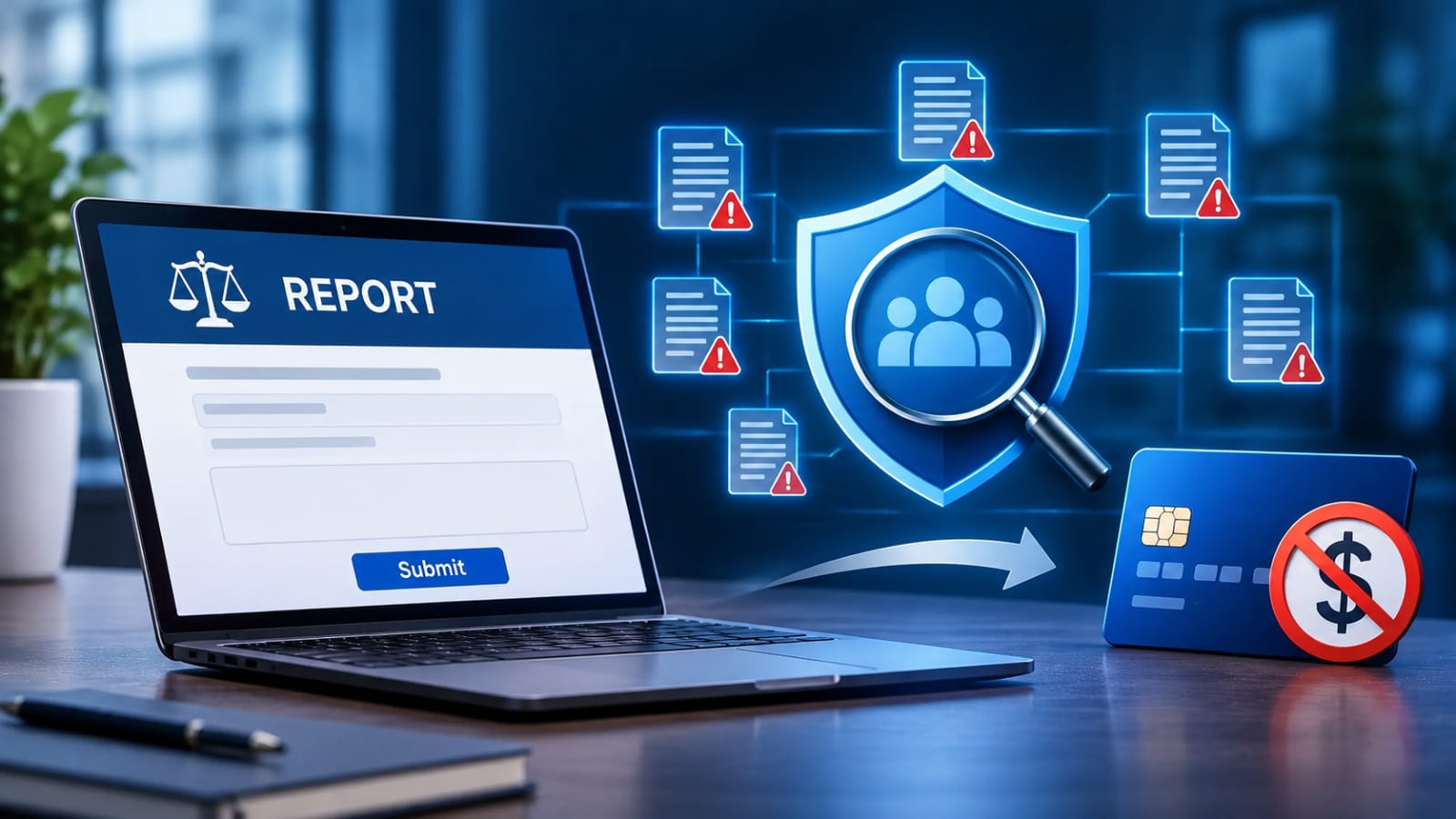
Someone told you to “report it to the FTC,” maybe a friend, your bank or a stranger in a forum reply, and it sounded like the thing that gets your money back. It isn’t. The Federal Trade Commission doesn’t resolve individual complaints, doesn’t contact the business for you, and doesn’t send you a refund because you filed. Its own reporting site says it can’t resolve your individual report.
That’s the honest answer, and it’s the one most people only find out weeks later, after they’ve waited for a call that never comes.
So is filing pointless? No. An FTC complaint does something real, it just does it at a much bigger scale than the one you’re hoping for. Your report goes into a national database that investigators use to find scam patterns and build cases against the people running them. Some of those cases end with money going back to victims, but that’s a long, indirect route, and it rarely starts with you.
This guide covers what an FTC report actually does, how to file one in about 15 minutes, and, most important, the other places you should report on the same day if you want any chance of getting money back.
The short answer, before the details
If you lost money in the last few days, read this part first, because the order matters more than anything else in this article.
- Call your card issuer, bank or payment app today. This is the only route with a real chance of reversing the payment, and every day you wait makes it harder.
- File at ReportFraud.ftc.gov. It won’t get your money back, but it puts the scam on the record that law enforcement searches.
- File with your state attorney general if the business is real and you can name it. Many AG offices will contact the business for you, which the FTC won’t do.
- Add the specialist channel for your situation: IdentityTheft.gov for stolen identity, the FBI’s IC3 for internet and crypto fraud, the CFPB for bank and card company problems.
That’s the full playbook in four lines, and the rest of this guide explains why each step exists and what each one can and can’t do.
How we put this guide together
Trustvivo is a review platform, so our team reads consumer complaints every week on business profiles, in reviews and in public complaint records. The question we see most after a bad purchase or a scam is some version of “I reported it to the FTC, so why hasn’t anyone called me?”
For this piece, our methodology was simple. We read the FTC’s own consumer pages and its reporting site, ReportFraud.ftc.gov, and we used the FTC’s published fraud figures, its annual refund report and its testimony to Congress on 2025 fraud data. For the money-back routes, we used the Consumer Financial Protection Bureau, the FBI’s Internet Crime Complaint Center and USA.gov. Where a rule or number comes from one of those sources, we name it. Where something is our read of how things tend to play out, we say so.
Trustvivo isn’t a law firm, and nothing here is legal advice. Card network rules and state programs vary, so check the exact deadline with your own bank.
What the FTC is, and why it doesn’t work your case
The FTC is a federal agency whose consumer protection job is to stop unfair and deceptive business practices across the whole country. It does that by suing companies, getting court orders and writing rules. It does not act as a complaint desk for individual disputes.
That distinction trips people up because “complaint” sounds personal: you file it, someone looks at it, and someone does something, the way a store’s customer service works. It’s roughly how the Better Business Bureau works, too, as we explained in our guide to what happens after you file a BBB complaint. The FTC is built differently, because it’s an enforcement agency, and enforcement agencies think in patterns rather than single cases.
Here’s a useful way to picture it. A single report saying “a caller pretending to be from Amazon took $400 in gift cards” isn’t a case. Ten thousand reports that share the same phone numbers, the same script and the same gift card brand start to look like one. The FTC needs your report to see the pattern, but it can’t spend staff time recovering your $400 specifically.
The agency’s own wording is direct: ReportFraud.ftc.gov tells people the FTC can’t resolve individual reports, but it uses them to investigate and bring cases against fraud, scams and bad business practices. Read that sentence twice, because it’s the whole relationship.
What actually happens to your report
Once you hit submit, your report goes into the Consumer Sentinel Network. Sentinel is a secure online database run by the FTC, and thousands of law enforcement agencies have access to it, including federal agencies, state attorneys general, local police departments and some international partners.
Investigators search Sentinel for a few things.
They look for repeat names, numbers and websites. If the phone number that called you shows up in 800 other reports, that number becomes a lead, and the same goes for a company name, a web domain, a payment handle or a bank account.
They look for growing trends. When reports about a new kind of scam start climbing, like fake toll texts or fake job offers, the FTC can issue public warnings while the scam is still spreading. Those consumer alerts on consumer.ftc.gov come straight from this data.
They look for evidence for cases already underway. When an agency is building a lawsuit against a company, victim reports help show how many people were harmed, how much they lost, and what they were told. Your narrative could end up in a court filing years from now, with your personal details protected.
Your report is not public. The FTC publishes aggregate numbers by scam type, payment method and state, but it doesn’t publish your name or your story. It may share your report with other law enforcement agencies, which is the point of the system.
The scale of the database
The numbers help explain why the FTC can’t work individual cases. According to the FTC’s Consumer Sentinel data for 2024, the network took in about 6.5 million reports that year. Around 2.6 million were fraud reports and about 1.1 million were identity theft reports. Consumers reported losing more than $12.5 billion to fraud in 2024.
Then 2025 got worse: according to FTC testimony to Congress in 2026, people filed roughly 3 million fraud reports in 2025 and reported about $15.9 billion in losses. Investment scams made up about $7.9 billion of that, roughly half. Imposter scams were the most reported category, with about $3.5 billion lost. People aged 60 and over reported about $3 billion in losses.
The FTC also notes that these are only the losses people report, and since most victims never file, the real totals are higher.
No agency can phone 3 million people back. A system that sorts millions of reports into patterns is the only kind that works at that size.
Do FTC cases ever send money back?
Yes, and this is where the “it won’t get your money back” answer needs a footnote that most guides leave out.
When the FTC wins or settles a case, the order often requires the company to pay money. The FTC then runs a refund program and sends payments to the people who were harmed. According to the FTC’s annual refund report, its actions led to $337.3 million in refunds to consumers in 2024. You can see current programs at ftc.gov/refunds.
Here’s the catch, and it’s the part nobody explains. Those refunds aren’t tied to whether you filed a report. The FTC usually identifies eligible people from the company’s own customer records. If you’re on the list, you get a check or a PayPal payment, and if you’re not, filing a report years earlier doesn’t add you.
The size gap is worth a look, too. We compared the 2024 refund total with the 2024 reported losses, and it comes to roughly $337 million returned against more than $12.5 billion reported lost, which is under 3 cents per dollar reported. The refunds that do go out often relate to cases that started years before, so even when it happens, it’s slow.
Why refunds got harder after 2021
There’s a legal reason refunds are rarer than many people assume. For decades, the FTC used a section of its governing law, Section 13(b), to ask courts for money back for consumers. In April 2021, the Supreme Court ruled in AMG Capital Management v. FTC that Section 13(b) doesn’t let the FTC win monetary relief that way.
Since then, the agency has leaned on slower routes. One newer tool matters for scam victims. The FTC’s rule on government and business impersonation took effect in April 2024. It lets the agency go to court directly to seek money back from people who impersonate government agencies or real companies. That covers a huge share of reported scams, such as the fake IRS agent, the fake bank fraud department and the fake Amazon support line.
That’s real progress, but it’s still a case-by-case enforcement tool. It doesn’t create a refund window for individual reporters.
How to file a complaint with the FTC, step by step
Filing takes about 10 to 20 minutes if you have your details ready, and there’s no fee, no account and no login. Here’s what to have on hand before you start.
- Dates: when you were first contacted and when you paid
- The amount and exactly how you paid (card, bank transfer, payment app, gift card, crypto, wire, cash)
- Every identifier the scammer used: phone numbers, email addresses, website URLs, social media handles, company names, payment usernames
- Copies or screenshots of messages, receipts and transaction IDs (you won’t upload these, but you’ll copy details from them)
The steps
Step 1. Go to ReportFraud.ftc.gov and click Report Now. If you’d rather talk to someone, call the FTC at 1-877-382-4357.
Step 2. Pick the category that’s closest to what happened. The options cover things like impersonators, online shopping, phone calls and texts, job and investment offers, and prizes or sweepstakes. Don’t worry about choosing perfectly, since investigators search the details and not just the category.
Step 3. Answer the follow-up questions. You’ll be asked whether you lost money, how much, how you paid, and how the person first reached you.
Step 4. Add information about the company or person. This is the most useful part of your report, so put in every phone number, web address and payment handle, typed exactly. A single correct phone number does more for investigators than a long paragraph of anger.
Step 5. Write your story in the comments box. Keep it short and in order, and say what they told you, what you did and when you realized something was wrong.
Step 6. Add your contact details if you’re comfortable. They’re optional, but including them lets investigators reach you if your report becomes evidence in a case.
Step 7. Submit and save the report number. You’ll get a page of next steps tailored to your situation, so save or print that page, because it often has the exact contact details for the payment company you used.
Which FTC channel to use
The FTC runs a few separate reporting sites. Using the right one gets your report to the right place.
| Your situation | Where to report |
|---|---|
| Scam, fraud or bad business practice | ReportFraud.ftc.gov |
| Someone used your identity, opened accounts or filed taxes in your name | IdentityTheft.gov |
| Unwanted sales calls or robocalls | DoNotCall.gov |
| Phone help for any of these | 1-877-382-4357 |
IdentityTheft.gov is the one that comes closest to “doing something for you.” It builds a personal recovery plan and pre-fills letters you can send to credit bureaus and businesses. If your identity was stolen, start there, not at the general fraud site.
DoNotCall.gov is also worth knowing. Registering your number is free, and if you still get sales calls after 31 days on the list, you can report them there. Those reports drive robocall enforcement, and robocalls are one area where report volume plainly shapes what the FTC goes after.
The places that can actually get your money back
This is the part most “how to file an FTC complaint” guides skip, and it’s the part that matters. If you want a refund, the FTC is the wrong first call, and these are the right ones, roughly in order of how often they work.
1. Your card issuer: the strongest route
If you paid by credit card, you have the most protection. Under the Fair Credit Billing Act, you generally have 60 days from the date the statement was sent to dispute a billing error in writing. That includes charges for things you never received or that weren’t as agreed. Your liability for unauthorized credit card charges is capped at $50, and most issuers waive even that.
Card networks often give more time than the law requires for some dispute types, but don’t plan around a longer window. Call the number on the back of your card the same day you realize something’s wrong, then follow up in writing. The FTC’s guide to disputing credit card charges has a sample letter.
Debit cards are weaker, and timing matters more. Under the Electronic Fund Transfer Act, if your card or PIN is lost or stolen and you report it within 2 business days, your loss is capped at $50. If you wait longer than that, the cap can rise to $500. If you don’t report an unauthorized transfer within 60 days of your statement, you could lose everything taken after that point.
2. The payment app, bank or transfer company
How you paid decides who to call next.
- Bank transfer or payment app (Zelle, Venmo, Cash App, PayPal): Call your bank or the app right away and ask about a fraud claim. Be ready for a hard truth: if you sent the money yourself, even after being tricked, many banks treat it as an authorized payment, which is much harder to reverse. Ask anyway, and ask in writing.
- Wire transfer: Call your bank and ask for a wire recall immediately. For Western Union, call 1-800-325-6000. For MoneyGram, call 1-800-926-9400. With wires, hours matter here, not days.
- Gift cards: Contact the company that issued the card, not the store where you bought it. Have the card number and receipt ready. Some issuers can freeze unspent balances if you’re quick. Gift cards are a favorite payment method for scammers, and so are sketchy card resale sites. Our look at whether MyGiftCardSupply is safe covers the red flags.
- Cryptocurrency: Report it to the exchange you used and to the FBI’s IC3. Be realistic, though, because crypto payments are rarely recovered.
3. Your state attorney general
Here’s the biggest practical difference between the FTC and your state. Many state attorney general offices run consumer mediation programs, where staff send your complaint to the business and ask it to respond, much like the BBB does, but with a government office on the letterhead. With a real, reachable company, like a retailer that won’t refund you or a contractor who took a deposit and vanished, that letter gets results more often than people expect.
Find your state’s consumer office through USA.gov’s state consumer protection directory or the National Association of Attorneys General. File with the AG in your state, and with the AG in the business’s state if it’s different.
A state AG can’t do much with an anonymous scammer overseas. For those, your bank and the FTC are the main moves.
4. The CFPB, if the problem is a financial company
If your complaint is about a bank, card company, lender, debt collector or money transfer service, file with the Consumer Financial Protection Bureau. Unlike the FTC, the CFPB forwards your complaint to the company and asks it to respond. According to the CFPB, companies generally respond within 15 days. That’s useful when your bank turns down a fraud claim and you think it got the decision wrong.
5. The FBI’s IC3 for internet fraud
The FBI’s Internet Crime Complaint Center takes reports of online fraud, including crypto investment scams, romance scams and business email compromise. Its 2024 annual report found that people reported $16.6 billion in losses to IC3 that year. For large, fast losses by wire, contact your bank first, then file with IC3 quickly. The FBI has a process for trying to freeze funds in some wire cases, and speed matters.
6. Local police
A police report is rarely what catches an online scammer, but some banks and insurers ask for one before they’ll process a fraud claim, and identity theft cases often need one. If you know who the person is, or the scam happened face to face, file locally too.
When FTC reporting matters most
Not every complaint helps investigators equally. Based on what the FTC publishes and how enforcement tends to work, reports carry the most weight in a few situations.
Repeat, scripted scams. Robocalls, fake toll texts, fake package delivery messages and tech support pop-ups all run from playbooks. The same numbers, links and scripts show up across thousands of victims. Each report is another data point that helps investigators link them together.
Impersonation scams. Fake government agents, fake bank fraud teams and fake brand support lines are now squarely covered by the 2024 impersonation rule. That gives the FTC a direct route to court, so evidence of harm counts for more.
Real businesses behaving badly. Subscriptions you can’t cancel, hidden fees and products that never match the ad come from companies with names and addresses. These are exactly the targets FTC lawsuits go after, and complaint volume helps show the practice is widespread. It’s also the kind of pattern we watch for when reviews start to look manipulated, which we wrote about in our guide on how to spot fake reviews.
Attempts that failed. You don’t need to have lost money to report, and when a scam call didn’t work on you, reporting the number still helps. An early report can show a new scheme before it hits thousands of people.
Reports help least when the facts are thin and there’s nothing for investigators to match. “Got scammed online, please help” with no number, no site and no amount gives investigators nothing to match. That’s why Step 4 above matters so much.
Watch for the scam that comes after the scam
This one deserves its own section because it’s both cruel and common, and we’ve seen it in complaint records again and again. After you report a scam, or post about it online, you may get a call, email or social media message from someone offering to recover your money. They might say they’re from the FTC, a law firm, a “fund recovery” company or a crypto tracing service. Either way, they’ll want a fee first.
That’s a scam, every time, and the FTC calls these refund and recovery scams. A few firm rules:
- The FTC never charges a fee to send you a refund.
- The FTC won’t call you to ask for your bank account details so it can send money.
- No legitimate agency asks you to pay in gift cards, crypto or wire transfer to release a refund.
- A company that promises to get your money back for an upfront fee is breaking the FTC’s rules on telemarketing.
Real FTC refunds arrive as a check or a PayPal payment, and you can confirm a program is real by checking the FTC’s refunds page yourself. Never use a link from the message.
Can you look up FTC complaints about a company?
People search for an “FTC complaint lookup” all the time, usually before buying from an unfamiliar company. The short answer is no, at least not instantly.
There’s no public search box for individual complaints. The FTC publishes aggregate data by scam type and state, and it names companies when it sues them. You can file a Freedom of Information Act request for complaints about a specific company. It works, but responses take time and the records come back with personal details removed.
For a decision you need to make today, other checks are quicker. Look up the business on your state attorney general’s site. Search the company name plus “FTC” to see if it has been sued. Read its complaint history on public review sites, looking for patterns rather than single angry posts. Our six-point check for whether a business is legit walks through it in about 10 minutes. If you’re looking at a website you’ve never heard of, start with our online scam checker guide.
A realistic timeline after you report
Here’s what to expect in the days and months after you file with the FTC, so the silence doesn’t feel like you did something wrong.
| When | What happens |
|---|---|
| Minute you submit | You get a report number and a tailored next-steps page. Save both. |
| Days 1 to 30 | Usually nothing. No call, no email. That’s normal. |
| Months later | Your report may be pulled into an investigation. You likely won’t be told. |
| Years later, sometimes | If a case ends in a settlement, the FTC may run a refund program. Eligibility usually comes from company records. |
Compare that with the money-back routes. A card dispute often gets a provisional credit or a decision within weeks. A state AG mediation often brings a business response within a few weeks. Under the Fair Credit Billing Act, card issuers generally must resolve disputes within two billing cycles, and no more than 90 days.
That gap is the whole reason the “file here too” checklist exists. The FTC report helps everyone a little and you specifically very little. The card dispute helps you specifically, right now.
Before the next one: the habits that prevent it
An FTC complaint you never have to file beats any you do, and most of the scams we’ve seen in complaint records share the same few warning signs.
- Pressure to act now. “Your account will be frozen in 30 minutes” is a script, not a real deadline.
- Unusual payment methods. No real government agency or major company asks you to pay in gift cards, crypto or a wire to a stranger.
- Contact you didn’t start. If someone calls claiming to be your bank, hang up and call the number on your card.
- Prices or returns that don’t add up. Investment “can’t-lose returns” and 80%-off designer goods are bait.
When you’re about to pay a business you haven’t used before, a two-minute check catches most problems. We keep ours in a short trust checklist to run before you pay.
The bottom line
Reporting a scam to the FTC is worth doing. It takes about 15 minutes, costs nothing, and adds your evidence to the database that drives real enforcement. Some of that enforcement does end with money going back to victims.
But it is not a refund request, and nobody at the FTC will call you about your case. If you want your money back, call your card issuer or bank first, today. Then file with the FTC, then your state attorney general, then the specialist channel that fits your situation. File in that order, keep every report number, and ignore anyone who offers to “recover” your money for a fee.
Lost money to a business that’s still operating? Check its record on Trustvivo, and leave a review of what happened. Reviews are public in a way FTC reports aren’t, and your account of what happened could be the warning the next buyer needs.
Frequently asked questions
Will the FTC get my money back if I file a complaint?
No. The FTC says plainly that it can't resolve individual reports. It doesn't contact the business for you, open a case for you, or send you a refund because you reported. Your realistic money-back routes are your card issuer or bank, the payment service you used, a state attorney general complaint, or small claims court.
What does the FTC do with my complaint?
Your report goes into the Consumer Sentinel Network, a secure database that thousands of federal, state, local and some international law enforcement agencies can search. Investigators use it to spot patterns, find repeat offenders and build cases. When a case ends in a settlement or court order, the FTC sometimes sends refunds to the people who lost money, whether or not they ever filed a report.
How do I file a complaint with the FTC?
Go to ReportFraud.ftc.gov and click Report Now, or call 1-877-382-4357. You'll pick the category that fits, explain what happened, say how you paid and how much, add any details about the company or person, and submit. Save the report number you get at the end. Identity theft goes to IdentityTheft.gov instead, and unwanted sales calls go to DoNotCall.gov.
Does the FTC contact you after you file a complaint?
Usually not. You get a report number and a page of next steps, but the FTC doesn't follow up on individual reports. If someone calls or emails claiming to be from the FTC and offering to recover your money for a fee, that's a scam. The FTC never charges to send a refund.
Can I look up FTC complaints against a company?
Not through a public search tool. Individual reports aren't published. The FTC posts aggregate data by scam type and state, and you can ask for complaints about a specific company through a Freedom of Information Act request, which comes back with personal details removed.
Is it worth reporting to the FTC if I didn't lose any money?
Yes. Reports of attempted scams help investigators see a scheme while it's still growing. Robocall, impersonation and fake-delivery scams in particular are tracked by the number of reports, so a report without a loss still counts.
Should I file with the FTC or my state attorney general?
Both, if the business is real and reachable. The FTC report feeds national pattern data. A state attorney general office often runs a mediation program that will actually contact a business on your behalf, which the FTC won't do. Neither replaces a chargeback if you paid by card.