Your State Attorney General Will Handle Your Complaint Differently Than You Think
Filing a complaint with your state attorney general can mean mediation, a pattern file, or a referral. How it really works, how it varies by state, and a link to every state's office.
· Trustvivo Editorial Team
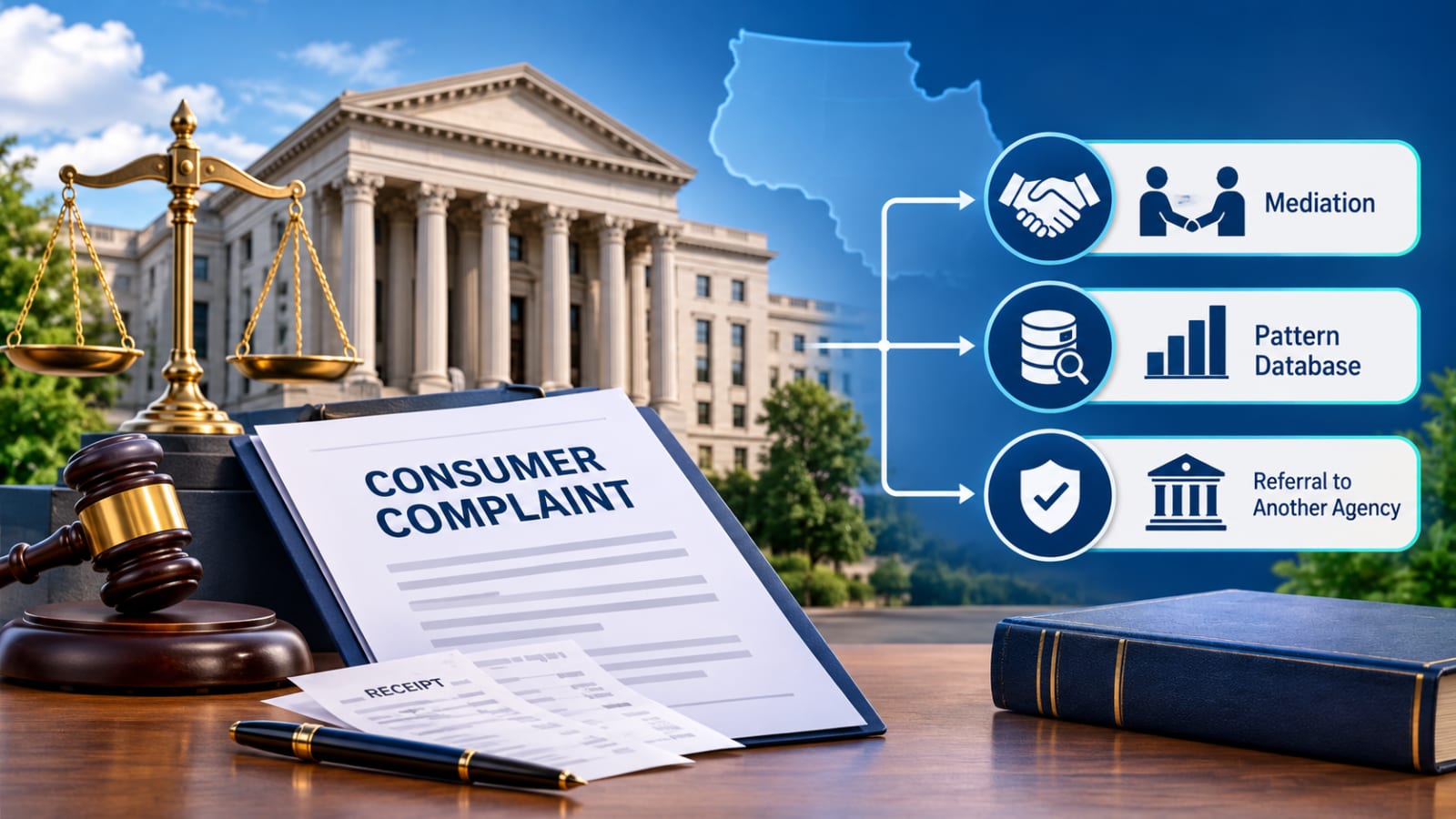
“File a complaint with your state attorney general.” It’s the line you get from a friend, a forum thread, sometimes even the company’s own frustrated ex-employee. It sounds like the moment someone with real power steps in and sorts it out.
Sometimes that’s roughly what happens. More often it isn’t, and the gap between those two outcomes depends heavily on which state you live in, which state the business is in, and what kind of problem you have. An attorney general’s office is not your lawyer. It won’t sue a company because you lost $340 on a sofa that never arrived. What it can do is quieter and, in the right case, more useful than people expect.
This guide explains the pattern that holds across all 50 states, where the states split, and when another channel will get your money back faster. Near the end there’s a link to every state’s consumer-complaint office, which we checked on 14 November 2026.
What a state attorney general’s consumer office actually does
Every state has an attorney general, the state’s chief legal officer. Most of those offices run a consumer protection division (the name varies: Consumer Frauds Bureau, Consumer Protection Section, Office of Consumer Protection). That division enforces the state’s consumer protection statute, usually called a UDAP law, short for “unfair and deceptive acts and practices.”
Those laws carry real teeth. California’s Unfair Competition Law allows civil penalties of up to $2,500 per violation. New York’s General Business Law lets the attorney general seek up to $5,000 per violation for false advertising. Texas’s Deceptive Trade Practices Act allows up to $10,000 per violation in a state enforcement case. Multiply any of those by a few thousand customers and you see why companies take an AG investigation seriously.
The key word is enforcement. The office represents the public interest of the state, not you personally. Its own complaint forms say so. California’s office states plainly that it can’t act as your private attorney or give you legal advice. Most other states carry similar language on their intake pages.
So what happens to your complaint? Broadly, it goes down one of three tracks.
1. Informal mediation. A staff member or trained volunteer sends your complaint to the business and asks for a response. There’s no legal obligation for the company to give you anything, but plenty do, because ignoring a letter on attorney general letterhead is a bad look. This is the track most people imagine, and it’s where individual refunds usually come from.
2. Logging and pattern review. Your complaint goes into a database. Nobody contacts the business for you, but investigators search those records when deciding where to look next. One complaint about a gym’s cancellation trap won’t move anything. Two hundred might.
3. Referral. If the problem belongs to another agency (a licensed contractor, an insurer, a bank, a doctor) the office may forward it, or tell you to file there instead. Insurance complaints, for example, nearly always belong with the state insurance department, not the AG.
Which track you land on depends on the state and on the complaint itself.
Why the process varies so much by state
Here’s the part most “how to file” pages skip. There isn’t one attorney general complaint process in the US. There are 51 of them if you count the District of Columbia, and per the National Association of Attorneys General, 56 attorney general offices in total once you add the five territories.
We compared the public complaint pages across those states while building the table below. Three structural differences stood out.
Some states mediate; some mostly log
A number of offices run a dedicated mediation unit whose whole job is contacting businesses on behalf of individual consumers. Maryland’s attorney general has a Mediation Unit inside its Consumer Protection Division. New York’s Bureau of Consumer Frauds and Protection says it tries to mediate complaints it receives. Massachusetts pairs the AG’s office with Local Consumer Programs run by cities and nonprofits, which handle much of the person-to-person mediation.
Other states state up front that complaints are reviewed for patterns and may not get an individual response. Neither model is wrong. They’re just built for different things, and knowing which one your state uses changes what you should expect in the next 30 to 60 days.
In some states, the AG isn’t the right office at all
This catches people out. In several states, consumer complaints go to a different agency entirely:
- Hawaii routes them to the Office of Consumer Protection, part of the Department of Commerce and Consumer Affairs.
- New Jersey uses the Division of Consumer Affairs, which sits under the attorney general but has its own site and forms.
- Utah sends them to the Division of Consumer Protection in the Department of Commerce.
- Wisconsin handles them through the Department of Agriculture, Trade and Consumer Protection (DATCP).
- South Carolina uses its Department of Consumer Affairs.
If you file with the “wrong” office, you usually get forwarded, but you lose a week or two. The table below points to the office that actually takes the complaint, not just the AG’s homepage.
Jurisdiction follows the business, not just you
You can almost always file in your own state. The office may also forward your complaint to the attorney general where the business is based, since that’s the office with the most direct power over it. When we’ve seen complaints stall, it’s often because the consumer filed only at home about a company two states away. Filing in both places is allowed and often smart.
Should you file with the AG, or somewhere else?
An AG complaint is one tool. Before you spend 40 minutes on the form, check whether a faster lever exists.
| Your situation | Best first move | Why |
|---|---|---|
| Paid by credit card, item never arrived or was misrepresented | Card dispute (chargeback) | Under the Fair Credit Billing Act you generally have 60 days from the statement date to dispute a billing error, and the issuer can reverse the charge |
| Problem with a bank, lender, credit report or debt collector | CFPB complaint | The CFPB forwards it to the company, which is expected to respond, typically within 15 days |
| Clear loss under your state’s small-claims limit, business is local and solvent | Small claims court | You get a judgment, not a request. Limits vary: $12,500 for individuals in California, $20,000 in Texas justice court, $10,000 in New York City |
| Scam, fake website, identity theft | FTC report plus your bank | The FTC feeds national pattern data, and your bank is the only realistic route to recovering funds |
| Real business, real dispute, they’ve stopped answering | AG complaint (mediation) | This is exactly what mediation units are for |
| Same business is doing this to lots of people | AG complaint, even if you’ve been refunded | Your complaint adds weight to a pattern file |
| Large loss, injury, or contract over several thousand dollars | Private attorney | The AG won’t represent you; a lawyer can |
A few honest notes on that table.
Chargebacks beat everything when they’re available. If you paid by card and you’re inside the window, start there the same day, then file with the AG in parallel. Waiting for mediation to fail first can push you past the dispute deadline.
The FTC and the AG do different jobs. We wrote a full breakdown of what an FTC complaint actually does, but the short version is that the FTC doesn’t resolve individual reports. Data from the FTC’s Consumer Sentinel Network shows consumers reported losing more than $12.5 billion to fraud in 2024, across roughly 2.6 million fraud reports, and the agency can’t mediate any of them one by one. A state AG with a mediation unit can at least ask a business to fix your specific case.
The Better Business Bureau sits in a similar spot: it’s a private nonprofit, not a regulator, and it can’t compel anything. Our piece on what happens after a BBB complaint covers when it helps. In our experience the BBB and the AG work well together, because businesses that care about their BBB rating often answer both.
Small claims is underrated. Filing fees are often $30 to $100, you don’t need a lawyer, and you walk out with an enforceable judgment. An AG complaint walks out with, at best, a polite request the company agreed to honour.
How AG complaints add up to enforcement
This is the part that makes filing worthwhile even when you don’t get a personal result.
Attorney general offices are small relative to the markets they police. They can’t investigate every bad review. They look for volume, repetition and harm: the same deceptive practice, from the same business, hitting many people. Your complaint is a data point in that picture.
When a pattern gets big enough, the office has options a single consumer never has. It can issue a civil investigative demand (a subpoena for business records), negotiate an “assurance of voluntary compliance” in which the company agrees to change its practices, or file suit under the state UDAP law. Settlements often include restitution, meaning money paid back to affected consumers, sometimes including people who never complained at all.
Large cases frequently become multistate actions, where dozens of attorneys general coordinate against one company. Those cases begin with complaint records in individual states. The complaint you file about a subscription you couldn’t cancel may sit quietly for 18 months and then turn out to be one of 900 that justified the investigation.
It’s the same structural point we make about BBB complaints: one report rarely changes a company’s behaviour, but the aggregate record is what regulators, journalists and future customers actually read. On Trustvivo we treat a business’s complaint history the same way when we look at whether a business is legit: the pattern matters far more than any single angry post.
How to file an attorney general complaint that gets read
Every state’s form looks a little different, but they ask for the same core facts. Our team went through the public forms for the larger states and the fields barely change. A complaint that answers these clearly gets triaged faster.
Before you start, gather:
- The business’s legal name, address, website and phone number (check the footer, receipt or state business registry, since trade names and legal names often differ)
- Dates: when you bought, when the problem started, every time you contacted the company
- Amounts: what you paid, how you paid, and what you’re asking for
- Copies of receipts, contracts, order confirmations, emails, chat logs and photos
- Your own attempts to fix it, with dates. Many offices expect you to have contacted the business at least once first
When you write the description:
Keep it chronological and factual. Lead with the one-sentence version: “I paid $1,180 on 3 September 2026 for a refrigerator that was never delivered, and the company has not answered 4 emails.” Then fill in the timeline. Skip the adjectives. Investigators read hundreds of these, and a clean, dated account is far easier to act on than a furious one.
Say exactly what resolution you want: a refund of $1,180, delivery by a firm date, cancellation of a contract. “I want them punished” isn’t something mediation can deliver.
After you submit:
Save the confirmation number. Expect an acknowledgment within a few days to a few weeks. If your state mediates, the business is usually given about 2 to 4 weeks to respond, and you’ll get a copy of its reply. If you don’t hear anything in 60 days, call and ask for the status using your reference number.
Keep watching your card statement window while you wait. Don’t let an AG complaint run out the clock on a chargeback.
A complaint to the attorney general is usually a public record, or can become one through a records request. Leave out unnecessary personal details like your full account numbers, and assume the business will see what you write.
Why some complaints get closed with no result
Not every complaint goes anywhere, and it helps to know the usual reasons before you file. We’ve seen the same handful come up again and again.
The business can’t be found. If the only details you have are a website and a Gmail address, the office has no one to contact. This is common with scam stores. Report those to the FTC and your bank instead.
It’s really a private contract dispute. Say a contractor did the job, but you think it was done badly. That’s a quality dispute, not deception. Offices often close these and suggest small claims or the state licensing board.
Another agency owns it. Insurance, banking, medical care, utilities and licensed trades usually have their own regulator. The AG may forward your file, or close it and tell you where to go.
The company answered. In mediation states, the file can close once the business replies, even if you don’t like the answer. You’ll usually get a copy of the reply. That letter is still useful. It’s a written statement from the company, and it can help in small claims later.
You didn’t say what you wanted. A form that tells the story but never asks for a fix is hard to mediate. Name a number or an outcome.
What to do when the business makes an offer
Mediation often ends with an offer, not a full refund. Maybe it’s 50% back. Maybe it’s store credit. You don’t have to accept it.
Think about three things. First, how strong is your proof? Second, what would small claims cost you in time and fees? Third, is the business likely to pay a judgment if you win? A fair partial refund today can beat a full judgment you can’t collect.
If you say no, tell the office why, in one or two lines. Then move to the next channel. Keep the offer letter, because it shows the company admitted at least part of the problem.
Before you file, check the business itself
Plenty of complaints that land at an attorney general’s office could have been avoided with five minutes of checking before payment. If you’re still deciding whether to deal with a business, run through our trust checklist before you pay and, for anything that smells off, an online scam checker walkthrough. Fake reviews are a common reason people trust a business they shouldn’t, so it helps to know how to spot fake reviews as well.
State-by-state attorney general complaint directory
Below is the office that takes consumer complaints in each state and DC. Where the AG isn’t the intake office, we’ve linked the agency that is.
Methodology: we built this list from each state’s official .gov site (or the official domain the state uses) and ran a link check on every address on 14 November 2026. We found that several state servers block automated checks, so a link that looks slow for you may simply be geofenced or filtering traffic; the office itself still exists. Government sites reorganise often, so we review this table every 6 months. If a link breaks, the NAAG directory is the fallback.
Most of these sites put the form under a “Consumer Protection” or “File a Complaint” menu. If you can’t find it in 2 clicks, search the site for “consumer complaint.”
The realistic bottom line
File with your attorney general when you have a real dispute with a real business that has gone quiet, or when you suspect you’re one of many people being treated the same way. Pair it with a chargeback if you paid by card, and with small claims if the business is local and the amount is clear.
Don’t expect a lawyer, a guarantee or a fast refund. Do expect your complaint to count. In states with mediation units, it can resolve your case in a few weeks. Everywhere else, it becomes part of the record that decides which companies get investigated next, and that’s the record Trustvivo readers benefit from when they check a business before paying.
Frequently asked questions
Will the attorney general get my money back?
Sometimes, but not because it represents you. In states with a mediation unit, staff contact the business and ask it to resolve your complaint, and many businesses do offer a refund. The office can't force a refund in an individual case. Money also comes back through restitution when the state wins or settles a larger case against a business.
How do I file a complaint with the attorney general?
Go to your state attorney general's website and look for Consumer Protection or File a Complaint. Most states take complaints online, and many also accept mail. Have the business's legal name and address, your dates, amounts, payment method, receipts and emails ready, plus a clear statement of the resolution you want.
Should I file in my state or the state where the business is located?
You can file in your own state, and you can also file with the attorney general where the business is based. That second office usually has the most direct power over the company. Filing in both is allowed, and your home state may forward the complaint anyway.
How long does an attorney general complaint take?
An acknowledgment usually arrives within a few days to a few weeks. In mediation states, the business is commonly given around 2 to 4 weeks to respond. If you hear nothing after about 60 days, call the office with your reference number and ask for a status update.
Is it better to file with the attorney general or the BBB?
They do different things. The BBB is a private nonprofit that forwards complaints and publishes a record, but it has no legal power. The attorney general enforces state consumer protection law and can investigate patterns. Filing with both is common and costs nothing.
Can I look up attorney general complaints against a company?
There's usually no public search tool. In many states, complaints are public records you can request through the state's public records law, sometimes with personal details removed. Some offices also publish press releases when they take action against a business.
When should I skip the attorney general and go to small claims court?
Go to small claims when you have a clear money loss under your state's limit and a local business you can serve. You get an enforceable judgment instead of a request. California allows claims up to 12,500 dollars for individuals, Texas justice courts up to 20,000 dollars, and New York City up to 10,000 dollars.